
Retirement Planning

Spotlight on SUAA: An Interview With Executive Director Bryan Soudy

Since our founding in 1999, Bluestem has forged a strong connection with those in higher education in our community. We have worked with, and continued to work with, many university professionals as they navigate retirement decisions within the State Universities Retirement System (SURS), and as a result, we’ve continued to deepen our expertise in this area. Recently, we’ve connected with the State University Annuitant’s Association (SUAA), an advocacy group for those participating in SURS, as there is great overlap in those we serve. Bluestem will be offering a series of webinars to SUAA members, as part of the ongoing educational opportunities they offer.

I reached out to Bryan Soudy, Executive Director of SUAA, and asked him to share a bit about the organization and the work that they do.

Can you share a bit about yourself, and your path to becoming the executive director of SUAA?

Bryan Soudy: My path to becoming an executive director started with the Illinois Society of Association Executives (ISAE), an allied organization with the American Society of Association Executives. My career started in legislative advocacy and by attending networking events with ISAE, and it evolved into first learning about the role of an executive director and the Certified Association Executive (C.A.E.) accreditation. I started attending the events primarily as a lobbyist seeking clients and ended up becoming one instead. ISAE helped me to learn and grow into the position of executive director. In 2012, I began lobbying for the American Red Cross in Illinois and in 2014, was promoted to executive director. After a few years in this role, an opportunity to serve as the executive director of the statewide Illinois Alliance of Boys & Girls Clubs, a 501(c)(4) organization, came up and I had the honor of serving there for several years before ultimately getting the opportunity to come “back home” to SUAA, which is also a 501(c)(4) organization.

I call SUAA home because my father was a SURS participant, and although he passed many years ago, his SURS pension is still of great importance to the family. When I advocate for the mission of SUAA, I always have my own family in mind and consider it a blessing to be able to serve in this way, and to bring the years of experience in both legislative advocacy and non-profit organizational management to work for SUAA, or my extended family, you might say.  

What would be your SUAA elevator pitch, for those who might be curious about the organization?

Soudy: SUAA serves all SURS participants, whether currently employed or retired. We are not a union, and we are not a state agency. We’re an advocacy group, and I believe we’re the only advocacy group working exclusively to engage, empower, and educate public higher education employees and retirees (SURS participants) to protect their pension and health care benefits while working to increase higher education funding, too.

SUAA membership is an amazing bargain with annual dues less than a dollar a week, yet SUAA has been at the forefront of every pension debate and battle in the State since 1971. SUAA also created, and continues to grow, a legal fund to ensure the fight for your earned benefits will continue in the courthouse, when the statehouse lets us down. The State of Illinois has a long track record of falling short in this regard. SUAA is an organization working and advocating in your interest to Illinois policymakers at every opportunity.

Can you share an example or two of what advocacy might look like, or share some wins the organization has had on behalf of its members?

Soudy: Absolutely and thanks for the opportunity to brag a little bit. One of SUAA’s biggest victories would have to be the passage of the compounded Cost of Living Adjustment (COLA) for higher education employees. I’m new to the organization as of January 2024, so I can’t share any exciting stories from the time, but it is an accomplishment that benefits all Tier 1 SURS participants with every payment they receive. The COLA is something that SUAA and the chapters at public higher education institutions around the state were apparently very effective in working to enact. That said, it’s important to remember all the other advocacy groups, unions and coalition members that made something like that possible. SUAA didn’t do it alone, but I think it’s fair to say they couldn’t have done it without us.

In the short space we have here it would be difficult to cover everything accomplished in nearly 60 years. Many legislative accomplishments could be listed, and I believe most would likely fall into the category of defending the benefits created, of protecting existing benefits and ensuring proper operations of government when necessary. But then Tier 2 happened in 2010, and it caught all the coalition partners by surprise due to an expedited legislative process that many still question its constitutionality to this day. I believe our greatest legislative accomplishment is yet to come. Fixing Tier 2 is our focus and our charge currently.

What are some of the benefits of becoming a SUAA member?

Soudy: We inform members when there is an issue that may impact you and your family’s well-being, and we provide networking events to make new friends and create opportunities to learn from experts on topics like financial planning, wealth management, and Social Security. There are also many member benefits through SUAA’s partner organizations. Unlike AARP or other retiree-focused organizations, people of all ages can join SUAA and take advantage of these benefits. Why wait until your 55 for a discount on a rental car? Discounted trip to Disney? A trip to Hawaii is offered currently if you get signed up in time. You can learn more about available benefits here.

What do you find most rewarding about the work that you do?

Soudy: I love serving in a member-driven, mission-focused organization dedicated to such a clear purpose and audience. As mentioned above, I welcome the opportunity to advocate for my (extended) family and its legacy. By extension, I believe every other SURS participant deserves the same. It may sound trite, but I feel like SUAA is working to ensure the benefits you earn today will continue to arrive as promised for you and yours, and that we all work together as one to ensure the continued viability of the overall Illinois Pension system itself. Although it can be very challenging, at SUAA we read that word as opportunity. We hope SURS participants will take the opportunity to join us.

You can learn more about SUAA by visiting their website.

Bluestem is independent of SURS. SURS remains the authoritative source for plan provisions and benefits.
SURS Tiers: What to Know About Your Benefits

The State Universities Retirement System (SURS) can be complex at times. What does it mean to be Tier 1 versus Tier 2? How does that affect one’s benefits? Does it matter for a participant who is in the Retirement Savings Program (RSP)? 

Know that Tier 1 vs Tier 2 benefits are not elective—there is no choice—it is based on the date in which you were first employed by an employer participating in the SURS system. Traditional, Portable, and RSP plans are a choice, and exist in both the Tier 1 and Tier 2 systems.

Here’s a brief primer on the difference:

history

Tier 1 is the “original” SURS.  Within this system, there were still the choices of the Traditional, Portable and Self-Managed Plan (now called the RSP). Because of budgetary concerns, the Illinois legislature passed Public Act 96-889, which instituted the Tier 2 benefits for participants starting employment on or after January 1, 2011. 

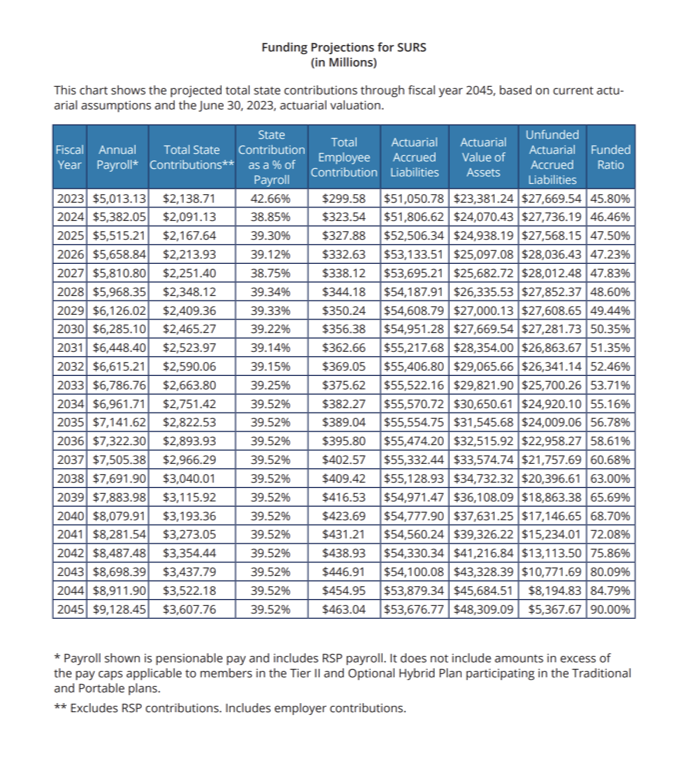
SURS funding solvency is always a hot topic when we meet with SURS retirees or soon to be retirees and could be a topic of a separate article. However, SURS funding is projected to improve over the next 20 years as Tier 2 participants begin to outnumber Tier 1 participants and retirees. We can see in the chart below (from the SURS website) that the funded ratio is only expected to increase onward from 2026. This is good news for participants, though the taxpayers of Illinois will need to bridge the gap in the intervening years.

Retirement Savings Plan

The retirement benefits under the RSP are the same for either Tier 1 or Tier 2 participants. In other words, the vesting requirements and retirement benefit options and savings rates are the same for participants no matter their hire date. 

The vesting period is still 5 years; the required employee and employer savings are the same rates and retirement age requirements are the same. An RSP participant will need 5 years of service at age 62, 8 years of service at age 55, or can retire at any age after 30 years of service. The benefit options are complex and entirely dependent on an individual’s complete financial situation. See Bluestem’s blog post for more detail on that. 

Traditional and Portable plan Differences

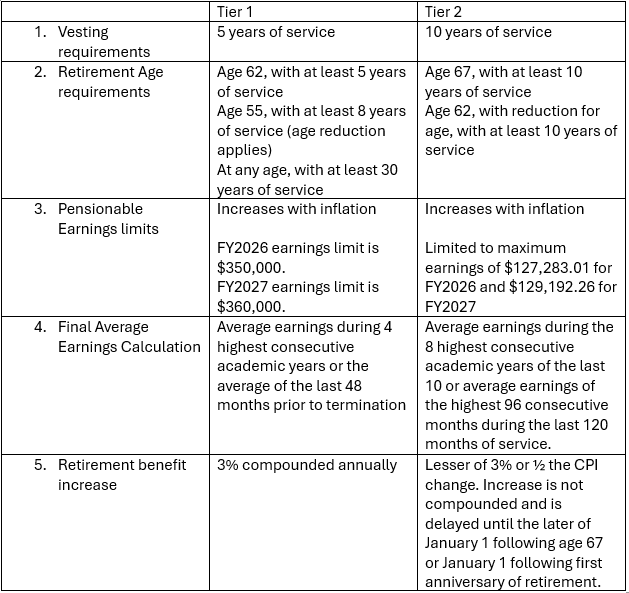
For these plans, there are significant differences between Tier 1 and Tier 2 participants.

The most significant differences are:

As you can see, Tier 2 is inferior in each of these major differences. This represents a savings in benefits SURS and the State are paying out, but also a major reduction in benefits and income for individuals who joined SURS eligibility after Jan 1, 2011. 

A person with Tier 2 benefits must draw their benefits at a later age, after more years of service, will likely be paid a smaller amount, and receive smaller annual increases.

how bluestem can help

Bluestem can assist in assessing choices around retirement readiness (under any of the above plans), help determine how your SURS benefits fit into your financial picture, and can provide education on the terminology and options of the SURS system. 

Additional information

SURS website: https://surs.org/

State Universities Annuitants Association (“SUAA”) website: https://www.suaa.org/home.  SUAA is an advocacy group which provides a unified message dedicated to preserving and protecting a strong public pension system, healthcare benefits, higher education, and the general well-being of its membership.

SUAA advocates on behalf of all faculty and staff of public universities and community colleges—both retired and current employees—their spouses and survivors, who are participants and beneficiaries of the State Universities Retirement System.

Important Disclaimer

This content has not been reviewed by or endorsed by State Universities Retirement Systems - SURS. Bluestem Financial Advisors, LLC, is an independent advisory firm not affiliated with SURS.

Faculty Phased Retirement at Illinois: A Practical Guide for Tenured and Specialized Faculty

In late 2025, the University of Illinois rolled out a new Faculty Phased Retirement Program (FPRP). This program offers tenured and other select faculty a way to build a glidepath into retirement while maintaining access to health insurance and other employee benefits. This guide offers our clients and those interested in this program an overview of the program as well as considerations for your retirement and financial plan.

Introduction to the FPRP

To qualify for the program, you must be tenured or specialized faculty at UIUC who will otherwise be eligible for retirement under the State University Retirement System (SURS) by the end of the 3-year program. Here is the eligibility for retirement under SURS (State Universities Retirement System, 2025a):

  • SURS Retirement Savings Plan, or Tier 1 Traditional / Portable - Age 55 with 8 Years of Service Credit, Age 62 with 5 Years of Service Credit, or any age with 30 Years of Service Credit.

  • Tier 2 Traditional or Portable participants - 10 Years of Service Credit at age 62.

Once accepted by your leadership and Dean, your appointment can be phased down over a period of up to three years. This allows you to stay involved in a part of your position you enjoy such as teaching, research, or supervising graduate students, and give up parts of your position you wish to reduce or eliminate. (Illinois Human Resources, 2025)

Impacts with your Pension and Retiree Health Insurance

It is important to understand this program does not change any of your elections within SURS or elect retirement under SURS. This reduces your appointment with UIUC with an agreement to fully retire by an agreed upon date. While health insurance is subsidized during this transition period, your retirement pension and health insurance benefits may be impacted.

SURS Traditional and Portable

Whether you are Tier 1 or Tier 2, your retirement benefits are determined based on a formula that factors in your years of service and final average salary. By opting into this program and reducing your appointment, you may accrue less service credit.

Example 1:

Sally is a 62-year-old professor in SURS Traditional that planned to work until age 65. She is interested in the FPRP program to see her graduate student through completion of his PhD as well as finish out her current grant funded research project. She currently has 17 years of service credit.

If she did not elect FPRP, she would accrue 3 more years of service credit and retire with 20 years at age 65. Assuming final average earnings of $150,000 and using the 2.2 rule, her pension would be $66,000 per year ($150,000 x 2.2% x 20). (State Universities Retirement System, n.d.)

If she elected FPRP, with a 66% appointment through age 65, she would only accrue 2 years of service credit over the final 3 years, ending with 19 years of service credit. Assuming Final Average Earnings of $150,000 and using the 2.2 Rule, her pension would be $62,700, a reduction of $3,300 per year.

Keep in mind, many of our faculty clients have additional sources of salary while working in a full-time appointment, such as drawing summer salary or salary supplements for leadership roles. If you were to give up these sources of income under the PFRP, you may see other impacts on your final pension calculation. These impacts would need to be calculated at the individual level as it can vary based on your final average salary and considering impacts of cost-of-living adjustments you may be entitled to if you retire earlier.

SURS Retirement Savings Plan

This pension plan determines benefits based on contributions and investment growth on the plan rather than years of service. By opting into this program, your salary would be reduced and therefore your own contributions and matching by your employer would be reduced.

Example 2:

Same facts as Example 1, except Sally is in SURS RSP. Sally contributes the mandatory 8% of her income to RSP and her employer matches this with 7.3% for total contributions of 15.3%.

Over the next 3 years and working full-time, her SURS RSP would receive contributions of $68,850 ($150,000 x 15.3% x 3).

If instead, she opts into the FPRP, her SURS RSP would receive contributions of $45,441 ($150,000 x 66% x 15.3% x 3) .

The exact impacts on retirement income are unknown as we cannot predict future investment returns or annuity rates. In either Example 1 or 2, Sally could consider “making up” some of this lost retirement income be increasing her voluntary retirement contributions via the 403b or 457 Deferred Compensation programs. However, this would further reduce her take-home pay beyond reduction in salary.

Health Insurance while Working

One of the primary benefits of the FPRP is the ability to maintain access to health insurance during the program at the same rates you pay during a full-time appointment. Normally, taking a reduced appointment that reduces your full-time equivalency below 1.0 would also come with a prorated increase in premiums to make up for the employer insurance premium subsidy. Under this program, your employer will make up that increased cost on your behalf. The details of these premium subsidies can be found at HR Resources Website - Insurance Impact Scenarios.

Health Insurance in Retirement

Once you complete the FPRP program and fully retire, you may have access to Retiree Health Insurance benefits. Eligibility of these benefits is based on your annuitization of your SURS pension and number of years of service credit. Read more about these benefits and eligibility requirements at Retiree Health Insurance Under SURS: An Explainer.

Notably, if you have less than 20 years of service reducing your appointment may reduce your eligibility for retiree health insurance benefits.

Example 3:

Going back to the facts in Example 1, if Sally does not opt into the FPRP and works until age 65, she will obtain 20 years of service credit. If she annuitizes her SURS pension, her retiree health insurance benefit is fully vested, and she will pay no premiums towards this benefit.

If she does opt into the FPRP and works until age 65 at a 66% appointment, she will only obtain 19 years of service credit. Upon annuitizing her SURS pension, she will be eligible for Retiree Health Insurance Benefits but will be responsible for 5% of the total cost each year. This is because health insurance premiums for retirees are based on number of years of service (State Universities Retirement System, 2025b).

Please note, at age 65, most participants will be required to opt into a Medicare Part A and Part B policy. While Part A generally has no premium when retired, Part B does have a Premium. You are responsible for Part B premiums, which are paid directly to Medicare, regardless of number of years of service credit. Upon reaching age 65, you would enroll in the Total Retiree Insurance Illinois Plan (TRAIL), which is currently a Medicare Advantage plan. The premiums on this are very low and therefore having less than 20 years of service credit has a minimal financial impact with regard to premiums. The impact is much larger for those retiring before age 65 or if Medicare Advantage premiums were to rise significantly later in retirement.

Bluestem’s View

The primary benefit of this program is providing flexibility in transitioning into retirement. We have seen some clients struggle with a sudden retirement, going from working full-time to fully retired. After the initial honeymoon period wears off, some feel a lack of structure and purpose without a longer period of transition. This program can provide a structured way to glide into retirement rather than making the transition from full-time work to retirement suddenly. If the time offered under this program is used to begin building post-retirement interests and purpose, it could be a positive program to consider.

See more on purpose in Money and Happiness Part II: Relationships, Purpose, and Fulfillment.

The maximum length of three years is also a downside of the program. It limits flexibility for those who still want to contribute over the long-term but adapt their work to their skills. Drawing on Arthur Brooks’ central theme from Strength to Strength, as our brains age, our cognitive strengths shift from problem-solving (“fluid intelligence”) to wisdom-based skills (“crystallized intelligence”) such as teaching, mentoring, and synthesizing knowledge. This transition can be a tremendous asset to both the university and the faculty member, as seasoned faculty can offer invaluable guidance, historical perspective, and mentorship to younger colleagues and students. Extending opportunities for experienced faculty to stay engaged beyond a fixed period allows the institution to benefit from these evolving strengths, while enabling faculty to continue making meaningful contributions in roles that leverage their accumulated expertise and insight.

Financial Considerations

The reality is, any decision to retire early is a “net negative” for the balance sheet as you are reducing your capacity to earn income, contribute to savings, and often drawing on savings sooner. That being said, if you are at or nearing financial independence, retirement is an opportunity to trade financial resources for something even more valuable — your time. As discussed above, the FPRP is likely to have some impacts on retirement income, but for many it may be manageable.

A more important consideration is, can you handle the salary reduction during the phased period? As you are not actually retired, you will not be eligible to draw your pension. Additionally, if you are not yet full retirement age for Social Security Benefits (typically 67), continued salary may limit your ability to draw benefits until you are fully retired.

In Summary

The Faculty Phased Retirement Program can offer welcome flexibility and a dignified glide path into retirement. Success depends on aligning your workload, annuitization date, and health insurance timing, subject to securing unit/dean approval. If you’d like a second set of eyes to weigh the trade‑offs and tailor a plan, especially around SURS options, retiree health insurance, and cash‑flow modeling our team is here to help. We’ve helped hundreds of faculty navigate SURS, retiree health insurance, and retirement decisions with clarity and confidence.

Schedule a call for an introductory call to learn more.

Further Reading

Illinois Human Resources. (2025). Faculty Phased Retirement Program. University of Illinois Urbana‑Champaign. https://humanresources.illinois.edu/faculty-phased-retirement-program/

University of Illinois System Human Resource Services. (n.d.). Retirement & Investment Plans. https://www.hr.uillinois.edu/benefits/retirement

State Universities Retirement System. (2025). Retiree Health Insurance and Rates. https://surs.org/benefits/insurance/

State Universities Retirement System. (2025). Retirement Eligibility. https://surs.org/retirement/eligibility/

State Universities Retirement System. (n.d.). Traditional Benefit Package – Guide [PDF]. https://surs.org/wp-content/uploads/Guide-TRD.pdf

Important Disclaimers

This content has not been reviewed by or endorsed by State Universities Retirement Systems - SURS. Bluestem Financial Advisors, LLC, is an independent advisory firm not affiliated with SURS.

Tip of the Month: 2026 Retirement Contribution Limits

Once again, January (or late December) is a good time to make sure your retirement contributions are on track to be maximized for the upcoming year, if cash flow allows. These thresholds are higher for 2026 than they were for 2025, so if you were already maximizing them in 2025, an adjustment may be necessary. In addition, there’s a new(er) law that allows those aged 60-63 to contribute an even larger amount. 

The new limits are $24,500 per year or $2,042 per month for those under the age of 50. For those who are over or will achieve the age of 50 during 2026, the limit is $32,500 for the year or $2,708 per month.    

Beginning in 2025, those who turned 60-63 by the end of the year are eligible for an increased “catch up” contribution. This would increase their annual maximum contribution to $35,750, or $2,979 per month. After age 63, the maximum is the $32,500 stated above. 

These limits apply to 401k, 403b, and 457 accounts. Making the adjustment as early in the year as possible, or in late December to be picked up on the first payrolls of January, will help to ensure you will hit the maximum by the end. Your Bluestem meetings where we look at your progress towards the maximum would be several months into the year, and could result in a “late” adjustment to get you on track for the maximum. 

Contact your HR, or payroll provider to make the adjustment. Or, if you are with the University of Illinois, you can make the adjustment at the following links:

403b: https://www.hr.uillinois.edu/benefits/retirement/403b/sra

457: https://www.hr.uillinois.edu/benefits/retirement/457/enroll

IRA and Roth IRA limits are increased for 2026 as well, with the under 50 maximum at $7,500 for the year and the 50 and over maximum at $8,600 for the year.

Tax Planning for Illinois Retirees and Pre-Retirees: Navigating the One Big Beautiful Bill

At Bluestem Financial Advisors, we believe that proactive planning starts with staying informed. Our commitment to clients goes beyond investment advice. We monitor tax and related legislative changes to help you understand what new laws and regulations mean for your financial life. Recently, we had the opportunity to share an overview of the most recent tax bill, the One Big Beautiful Bill Act (OBBA), with members of the State Universities Annuitants Association (SUAA). Here is a summary of what we covered, including key strategies and planning opportunities for retirees and pre-retires.

Overview of Tax Legislation Since 2017

We began with a broad overview of tax law changes since 2017, including the Tax Cuts and Jobs Act (TCJA) and the significant overhauls brought by the SECURE Act. These changes have shaped the retirement landscape, especially regarding how retirement accounts are treated after the owner’s death. The SECURE Act, for example, eliminated the “stretch IRA” for many non-spouse beneficiaries, requiring faster distributions and potentially higher taxes for heirs.

The OBBA: What’s New and What’s Extended

The One Big Beautiful Bill Act (OBBA) primarily extends the lower tax rates and higher standard deductions introduced by the TCJA, with new inflation adjustments. For retirees, the new “enhanced senior deduction” offers an additional $6,000 per person age 65+, though it phases out at higher incomes and is set to expire after 2028. We discussed how these provisions can impact your annual tax bill and why it’s important to review your filing strategy each year.

State and Local Tax (SALT) Deduction – Especially for Illinois Residents

The increased cap up to $40,000 on state and local tax (SALT) deductions can be a game-changer. We highlighted how this opens the door for “bunching” strategies: by timing property tax and charitable payments, you can maximize deductions in alternating years. This is especially relevant in Illinois and other states where property taxes and state income taxes are significant.

Charitable Giving Opportunities

We explored several ways to make your charitable giving more tax-efficient:

  • Above-the-line charitable deduction (starting in 2026) for those who don’t itemize.

  • Qualified Charitable Distributions (QCDs) from IRAs for those age 70½+, which can reduce taxable income, lower Medicare premiums, and help maintain eligibility for senior deductions.

  • Why QCDs remain a powerful tool even as other charitable deduction rules change.

Roth Conversions: Leveraging Lower Tax Brackets

We highlighted how to utilize lower tax brackets before and early in retirement to avoid higher taxes later. By converting traditional retirement assets to Roth IRAs during lower-income years before Social Security and Required Minimum Distributions (RMDs) begin you can reduce future tax burdens and gain more flexibility in retirement income planning.

Social Security: An Overview and Impacts to Retirees

We provided an overview of recent Social Security changes, including the repeal of the Windfall Elimination Provision (WEP) and Government Pension Offset (GPO). These changes mean higher Social Security benefits for many SURS retirees but also create new planning considerations. We cautioned those who receive retroactive payments that could affect their tax bracket or Medicare premiums.

Watch the full webinar for detailed examples and Q&A:

At Bluestem, we see a tremendous opportunity to integrate tax planning into our retirement and planning strategies. By staying ahead of legislative changes and thoughtfully coordinating your tax, investment, and income decisions, we help you maximize your resources and adapt your plan as your life evolves.

If you’re interested in a more integrated approach to tax and retirement planning, we invite you to schedule a conversation with our team. Let’s work together to build a strategy that’s as dynamic as your life.

SURS Retirement Savings Plan Guide Part 1 – The SURS Secure Income Portfolio (SIP)

SURS Retirement Savings Plan Guide Part 1 – The SURS Secure Income Portfolio (SIP)

Welcome to Part 1 of our multi-part series designed specifically for members of the State Universities Retirement System Retirement Savings Plan (SURS RSP) who are approaching retirement and want clear guidance on their options. This guide will help you make sense of your choices and confidently decide what to do with your account balance as you transition to retirement.

Breaking News: Social Security Fairness Act Reform Signed into Law

Breaking News: Social Security Fairness Act Reform Signed into Law

President Biden has officially signed the Social Security Fairness Act (HR 82) into law on January 6, 2025, revoking the Windfall Elimination Provision (WEP) and Government Pension Offset (GPO) under Social Security. Here we outline what WEP and GPO are, how they impact benefits, and what this change means for those at different stages of their financial journey.

Making Sense of Medicare IRMAA, a Universally Confusing Topic

Making Sense of Medicare IRMAA, a Universally Confusing Topic

The forename Irma is of Germanic origins and means “universe.” For many retirees, Medicare IRMAA is of universally confusing origin. In this article we’ll cut through some of the bewilderment, and hopefully leave you with a sounder understanding of IRMAA’s purpose, calculation, and planning opportunities.

Alert for University of Illinois Employees: Open Enrollment for Supplemental Long-Term Disability Benefits through March 10, 2023

Alert for University of Illinois Employees: Open Enrollment for Supplemental Long-Term Disability Benefits through March 10, 2023

Disability insurance is often overlooked and, in many cases, more important than life insurance. This is something that we stress with our clients when reviewing their risks and insurance needs. Open Enrollment for Supplemental Long-Term Disability Benefits through March 10, 2023!

Four Considerations When Retiring with SURS Retirement Savings Plan

Introduction

To be or not to be, that is the question. A binary choice. In the past, a SURS Self-Managed Plan (SMP) participant once had a binary choice like this. Annuitize or not annuitize. Annuitization would ensure a lifetime stream of income and the retiree health insurance. By not annuitizing, or taking the lump sum option, one was turning down the health insurance and assuming the risk of portfolio management.

Along with the rebranding of the SMP to the SURS Retirement Savings Plan (RSP), more choices were added. With more choices comes more complexity. Participants may still choose to annuitize the lump sum as they have in the past. Alternatively, one may choose to use the new Secure Income Portfolio (SIP). Some of the new benefits SIP affords are:

1) the potential to have one’s retirement income stream increase with market returns, and

2) the ability to leave the residual value of one’s SURS account to heirs at death.

Along with these new choices come more options. One new choice is the ability to only use half of the account to produce guaranteed income and still maintain state-provided health insurance. This ability provides guaranteed income through the Secure Income Portfolio (“SIP”). The remaining 50% would be kept in the Lifetime Income Strategy (“LIS”) and can be accessed as needed.

To review a more comprehensive explanation and analysis of the new RSP, you can download a whitepaper we authored here.

What we have learned

As we have begun to assist clients through the retirement process since the change from SMP to the new RSP Plan, here are a few items we have learned along the way.

Retiring before age 60

There are different rules for participants retiring before age 60 when using the SIP.

If you choose to have some balance remain in LIS and not be subject to the guaranteed payout through the SIP, you can’t access the amount in the LIS until you turn age 60. One benefit of using the SIP is that you can choose to only use half the account for generating pension income and still qualify for the health insurance benefit. After age 60, the other half – the LIS half – can be used or withdrawn as desired. However, prior to age 60 that freedom to withdraw the account does not apply.

If you retire before age 60, your SIP benefit cannot yet increase with market increases – it is “locked” until age 60. Just like at age 60 and later retirement, the benefit amount may not go down. The “floor” is set at retirement. Once one reaches age 60, benefit increases due to market gains can be granted. If market decreases do happen between retirement and age 60, the principle in the LIS account is reduced even though the benefit is not.

Flexibility at a cost: tradeoff between income and principal

The benefit of using the SIP includes:

• ability to allocate a portion of your account balance to draw upon at your discretion

• ability to leave the leftover balance of your account to a beneficiary and heirs at death

• ability for guaranteed income to increase overtime with the performance of investments

However, these benefits come with an expense – you could potentially receive a smaller pension relative to other options.

The pension amount can be expressed as a withdrawal rate, which is the annual benefit divided by the total lump sum balance. For example, a pension benefit of $5,000 per month or $60,000 per year on a $1 million account balance equates to a withdrawal rate of 6%. When activating the SIP, or annuitizing your balance, rates will depend on a variety of factors including, but not limited to: age, whether a survivor benefit is being provided, and market rates at retirement.

Under recent rates, if one is age 65 with no survivor benefit and annuitizes the account (without using the SIP), a withdrawal rate of 7.4% could be expected.¹ If the same individual uses the SIP they could expect a withdrawal rate of 4.81%.² In real dollar terms in this example, with a $1,000,000 balance, it would mean the difference between receiving $6,183 per month and $4,008 per month.

In this example, the monthly pension benefit is only 65% of what it might have been had the account been fully annuitized. One might think “I worked hard all these years and this is all I get?” Keep in mind, you are giving up some monthly benefit in order to potentially get future rate increases, and to preserve that value for heirs.

Do not forget balances at TIAA and Fidelity

While most assets were transferred to Voya during the changeover to RSP, some legacy funds may still exist at TIAA or Fidelity. At retirement, remaining balances in TIAA or Fidelity need to be annuitized with that company or transferred to Voya and incorporated into the SIP. One of these two actions are mandatory to qualify for and enroll in the SURS health insurance benefit. This would apply even if the TIAA balance is extremely small and would not produce much monthly income.

Choose wisely, your decision is irrevocable

Once your lifetime benefit in the LIS Secure Income Portfolio is “activated,”³ there’s no going back. One cannot later terminate the contract and take the entire LIS and SIP balance for one’s own. This might apply if you are an early retiree (before Medicare age 65) and need the SURS health insurance. Before 65 the health benefit is large but diminishes following enrollment in Medicare. At 65, if you were to want to terminate enrollment, and take the lump sum balances for one’s own management and quit paying the higher fees for benefits you’re no longer using, the rules would prevent enacting this strategy.

Footnotes

[1] Principal Life Insurance Company Illustrative Table of Annuity Premiums for SURS Rates as of October 1, 2022

[2] Chart – SURS Blended Rates- Rolling Periods, Lifetime Income Strategy – Q4 2022

[3] SURS Retirement Savings Plan Member Guide, page 22, https://surs.org/wp-content/uploads/Guide-RSP.pdf

Retiree Health Insurance Under SURS

Introduction

We have found that retiree health insurance benefits can be the most common point of confusion for State of Illinois employees retiring under the State University Retirement System (SURS). In this post, we will break down the basics of the Retiree Health Insurance Benefit, how to qualify, and the features and drawbacks of this benefit.

Special Note for SURS Retirement Savings Plan participants: In fall of 2020, SURS rolled out the newly rebranded SURS Retirement Savings Plan (RSP), which has added another layer of complexity. See the whitepaper we wrote for a more detailed overview of this change.

Qualifications

Service Credit

To begin, let’s discuss the qualifications for retiree health insurance benefits. The first requirement is service credit. Service credit can vary based on your SURS membership Tier, which is determined by the date of first employment under a SURS covered employer. For anyone with service credit prior to January 1, 2011, you are considered a Tier I participant. A Tier I participant is eligible for retiree insurance benefits after 5 years of service credit. Anyone beginning service credit on or after January 1, 2011 is a Tier II participant. 10 years of service credit is required for Tier II participants to be eligible for any retiree health insurance benefit.

The service credit discussed above is the minimum requirements to be eligible for retiree health insurance. Meeting the minimum service credit requirements only provides for a subsidy of the cost of this benefit. To have your insurance fully subsidized by the State of Illinois, you need 20 years of service credit. Members who meet the minimum coverage requirements and have less than 20 years split the cost of coverage with the state. The chart below summarizes this cost split:

Costs above are for the employee only. Coverage for a spouse or dependents is available for an additional cost.

Annuity Election

The second requirement in addition to meeting the service credit requirements to qualify for retiree health insurance is to annuitize your pension. If you separate from service and defer taking a monthly retirement benefit under SURS, you would not be entitled to the retiree insurance benefit until you have annuitized your pension plan. Taking a refund of your pension plan balance, including rolling over your plan balance to an IRA or other retirement plan will result in a forfeiture of retiree health insurance benefits.

Annuitization of SURS is the process of converting your benefit into a stream of income payable monthly for the remainder of your life. For the Traditional and Portable plan, this is fairly straightforward. Your pension is based the higher of two formulas which SURS will calculate for you. Your main decision is whether to select a survivor benefit for your spouse or a qualified dependent.

The Retirement Savings Plan has more flexibility, which makes annuitizing a bit more complex. Here is a summary of your options.

1.    Annuitize the entire balance of your SURS RSP. This annuity will generally be administered for SURS through Principal Insurance company, or at TIAA if you still have funds in your RSP portfolio invested at TIAA.

2.    Move at least 50% of your RSP portfolio balance into the SURS Secure Income Portfolio and activate the lifetime income benefit. When selecting this option, all RSP investment funds not otherwise annuitized must be first moved into the Lifetime Income Strategy (LIS) portfolio. Next, with all non-annuitized RSP funds in the LIS portfolio, at least 50% of those LIS funds must then be moved into the SIP with its guaranteed income benefit. After moving all funds into the LIS and activation of at least 50% of your LIS fund total into the guaranteed SIP, any LIS funds not in the SIP may be moved back to RSP Core Funds or withdrawn.

3.    A combination of Options 1 & 2 – for example, you could use 1/3rd of your RSP account to buy an annuity through Principal. With the remaining RSP balance, allocate 50% to the SIP for lifetime income and 50% to the LIS or Core Funds for periodic withdrawal.

We have commonly heard the misconception that RSP participants must use the new SIP to maintain health insurance, which is not true. Electing an annuity remains an option.

Timing of Retiree Health Insurance

It is possible to retire from the University and delay drawing your pension. This may be beneficial if you have alternative insurance coverage through new employment or a spouse. Deferring your benefit has two potential benefits. First of all, your pension benefit (traditional or portable) may increase or the balance of your account can continue to grow (RSP). Secondly, if you are not yet Medicare-eligible, the State of Illinois will pay an additional monthly incentive to opt out of retiree insurance.

Example 1

A University Employee has 20 years of service at age 50, at which point she leaves university employment to pursue a second career with a private sector employer. The new employer offers health insurance. The employee leaves her account balance with the SURS RSP, which allows the balance to continue to grow. At age 63, she fully retires from her private sector position and needs health insurance. At this point, she activates one of the RSP income options to qualify for health insurance as a State of Illinois retiree.

The Value of Retiree Health Insurance under SURS

There may be cases where an individual chooses to forgo their SURS retiree health insurance benefits, but before making this irrevocable decision, it is important to understand what those health insurance benefits are worth.

How SURS Retiree Health Insurance works with Medicare

Those in the SURS RSP are also required to participate in Medicare. While working, everyone pays into the Medicare system. Upon turning age 65, you must sign up for Medicare. If you are still working and covered by your University insurance, you only need to enroll in Medicare Part A, but may delay Part B until you retire.

Medicare has three parts:

  • Part A, which covers Hospital services and is generally free for those age 65+

  • Part B, which covers doctor visits and other outpatient services. Part B has a monthly premium starting at $170.10 (2022); cost can increase based on income.

  • Part D, which covers prescription drug costs

Once you retire and become a SURS annuitant aged 65 or older, you are required to enroll in the Total Retiree Advantage Illinois (TRAIL) plan, managed through Illinois Central Management Services (CMS). This is a Medicare Advantage plan, which means it combines Medicare Part A, Part B, Part D and a Medicare Supplemental Policy (commonly known as a Medigap policy). Even under the TRAIL program, you still must pay the Medicare Part B premiums on your own. The State of Illinois subsidizes (or entirely covers) the rest of your supplemental health cost.

How much is this SURS health insurance subsidy worth? 

For a retiree with 20 or more years of service, age 65 or older and on Medicare, the value of this benefit is around $150 per month. This is based on the amount the State of Illinois covers for the cost of the Advantage Plan (Illinois Central Management Services, 2022).

For a retiree with 20 or more years of service and under the age of 65, the SURS health insurance benefit is significantly more valuable. Prior to Medicare eligibility, the State picks up the entire cost of their health insurance. For those retiring before age 65, the cost of health insurance can be a significant obstacle.  For example, marketplace plans at healthcare.gov range in cost from $1,165 to $1,791 for a 60 year old male in the Champaign County area.

Conclusion

Health Insurance is one of the biggest obstacles we see for clients who wish to retire prior to eligibility for Medicare at age 65. If you are retiring early from the University, it could be a valuable benefit. The requirement to annuitize is the biggest obstacle, especially for those in the SURS Retirement Savings Plan. Once you are Medicare eligible, the value of the insurance benefit is less valuable as Medicare covers a significant portion medical expenses and Medicare supplement policies are low in cost as compared to private health insurance.

Update on Illinois Retiree Insurance

We have heard from many of our clients regarding concerns over the change in Insurance Providers for State of Illinois Medicare-Eligible Retirees. With so many clients impacted by this change, we have been following the news. Here is what we know so far and what we are recommending.
 
Starting with what we know, it is not much. We wrote up a short piece on our website on this a few weeks back, which you can read here. The major concern at this time is that Carle has not come to an agreement with the Advantage Plan Provider, Aetna. This means that Carle providers and facilities are not in-network for the new plan effective January 1, 2023. While the new plan is a PPO and should allow you to see out-of-network doctors, these services may not be covered if the provider is unwilling to bill through Aetna.
 
As far as we can tell, conversations between Carle and Aetna are ongoing and there is a possibility that an agreement will be reached before the new plan year. This would not be unprecedented. A similar process unfolded about 10 years ago when Health Alliance was dropped in favor of UnitedHealthcare. Recent comments from Carle and Aetna representatives may be more attempts to rally public pressure for negotiations than statements of actual status of negotiations.
 
The unfortunate part is this leaves a lot of uncertainty for current plan participants. Here is what we are recommending:
 
If you are currently undergoing treatment for chronic or critical medical issues and absolutely cannot switch doctors, be prepared to switch to a private policy:

  • November 30th – Deadline to opt out of the TRAIL / State of Illinois Medicare Plan

  • December 7th – Deadline for Medicare Open Enrollment to select your own private plan

  • Research Alternative Plans - Medicare's Website is the best resource as you can narrow in to providers covered in your area.

    • Private policies generally run $50-175/month/person, but can be higher or lower depending on deductible, co-pays, etc.

    • Inputting your current prescriptions will provide you a better total out of pocket cost estimate.

    • Pay attention to vision and dental coverage.


For everyone else, it is probably best to take a wait-and-see approach. If Carle and Aetna reach an eleventh hour agreement, you avoid all the hassle of unenrolling and reenrolling from TRAIL next year. If they do not reach an agreement, you could also unenroll from TRAIL during the next enrollment period near the end of 2023.