Retirement Planning

Tip of the Month: 2026 Retirement Contribution Limits

Once again, January (or late December) is a good time to make sure your retirement contributions are on track to be maximized for the upcoming year, if cash flow allows. These thresholds are higher for 2026 than they were for 2025, so if you were already maximizing them in 2025, an adjustment may be necessary. In addition, there’s a new(er) law that allows those aged 60-63 to contribute an even larger amount. 

The new limits are $24,500 per year or $2,042 per month for those under the age of 50. For those who are over or will achieve the age of 50 during 2026, the limit is $32,500 for the year or $2,708 per month.    

Beginning in 2025, those who turned 60-63 by the end of the year are eligible for an increased “catch up” contribution. This would increase their annual maximum contribution to $35,750, or $2,979 per month. After age 63, the maximum is the $32,500 stated above. 

These limits apply to 401k, 403b, and 457 accounts. Making the adjustment as early in the year as possible, or in late December to be picked up on the first payrolls of January, will help to ensure you will hit the maximum by the end. Your Bluestem meetings where we look at your progress towards the maximum would be several months into the year, and could result in a “late” adjustment to get you on track for the maximum. 

Contact your HR, or payroll provider to make the adjustment. Or, if you are with the University of Illinois, you can make the adjustment at the following links:

403b: https://www.hr.uillinois.edu/benefits/retirement/403b/sra

457: https://www.hr.uillinois.edu/benefits/retirement/457/enroll

IRA and Roth IRA limits are increased for 2026 as well, with the under 50 maximum at $7,500 for the year and the 50 and over maximum at $8,600 for the year.

Tax Planning for Illinois Retirees and Pre-Retirees: Navigating the One Big Beautiful Bill

At Bluestem Financial Advisors, we believe that proactive planning starts with staying informed. Our commitment to clients goes beyond investment advice. We monitor tax and related legislative changes to help you understand what new laws and regulations mean for your financial life. Recently, we had the opportunity to share an overview of the most recent tax bill, the One Big Beautiful Bill Act (OBBA), with members of the State Universities Annuitants Association (SUAA). Here is a summary of what we covered, including key strategies and planning opportunities for retirees and pre-retires.

Overview of Tax Legislation Since 2017

We began with a broad overview of tax law changes since 2017, including the Tax Cuts and Jobs Act (TCJA) and the significant overhauls brought by the SECURE Act. These changes have shaped the retirement landscape, especially regarding how retirement accounts are treated after the owner’s death. The SECURE Act, for example, eliminated the “stretch IRA” for many non-spouse beneficiaries, requiring faster distributions and potentially higher taxes for heirs.

The OBBA: What’s New and What’s Extended

The One Big Beautiful Bill Act (OBBA) primarily extends the lower tax rates and higher standard deductions introduced by the TCJA, with new inflation adjustments. For retirees, the new “enhanced senior deduction” offers an additional $6,000 per person age 65+, though it phases out at higher incomes and is set to expire after 2028. We discussed how these provisions can impact your annual tax bill and why it’s important to review your filing strategy each year.

State and Local Tax (SALT) Deduction – Especially for Illinois Residents

The increased cap up to $40,000 on state and local tax (SALT) deductions can be a game-changer. We highlighted how this opens the door for “bunching” strategies: by timing property tax and charitable payments, you can maximize deductions in alternating years. This is especially relevant in Illinois and other states where property taxes and state income taxes are significant.

Charitable Giving Opportunities

We explored several ways to make your charitable giving more tax-efficient:

  • Above-the-line charitable deduction (starting in 2026) for those who don’t itemize.

  • Qualified Charitable Distributions (QCDs) from IRAs for those age 70½+, which can reduce taxable income, lower Medicare premiums, and help maintain eligibility for senior deductions.

  • Why QCDs remain a powerful tool even as other charitable deduction rules change.

Roth Conversions: Leveraging Lower Tax Brackets

We highlighted how to utilize lower tax brackets before and early in retirement to avoid higher taxes later. By converting traditional retirement assets to Roth IRAs during lower-income years before Social Security and Required Minimum Distributions (RMDs) begin you can reduce future tax burdens and gain more flexibility in retirement income planning.

Social Security: An Overview and Impacts to Retirees

We provided an overview of recent Social Security changes, including the repeal of the Windfall Elimination Provision (WEP) and Government Pension Offset (GPO). These changes mean higher Social Security benefits for many SURS retirees but also create new planning considerations. We cautioned those who receive retroactive payments that could affect their tax bracket or Medicare premiums.

Watch the full webinar for detailed examples and Q&A:

At Bluestem, we see a tremendous opportunity to integrate tax planning into our retirement and planning strategies. By staying ahead of legislative changes and thoughtfully coordinating your tax, investment, and income decisions, we help you maximize your resources and adapt your plan as your life evolves.

If you’re interested in a more integrated approach to tax and retirement planning, we invite you to schedule a conversation with our team. Let’s work together to build a strategy that’s as dynamic as your life.

SURS Retirement Savings Plan Guide Part 1 – The SURS Secure Income Portfolio (SIP)

SURS Retirement Savings Plan Guide Part 1 – The SURS Secure Income Portfolio (SIP)

Welcome to Part 1 of our multi-part series designed specifically for members of the State Universities Retirement System Retirement Savings Plan (SURS RSP) who are approaching retirement and want clear guidance on their options. This guide will help you make sense of your choices and confidently decide what to do with your account balance as you transition to retirement.

Breaking News: Social Security Fairness Act Reform Signed into Law

Breaking News: Social Security Fairness Act Reform Signed into Law

President Biden has officially signed the Social Security Fairness Act (HR 82) into law on January 6, 2025, revoking the Windfall Elimination Provision (WEP) and Government Pension Offset (GPO) under Social Security. Here we outline what WEP and GPO are, how they impact benefits, and what this change means for those at different stages of their financial journey.

Making Sense of Medicare IRMAA, a Universally Confusing Topic

Making Sense of Medicare IRMAA, a Universally Confusing Topic

The forename Irma is of Germanic origins and means “universe.” For many retirees, Medicare IRMAA is of universally confusing origin. In this article we’ll cut through some of the bewilderment, and hopefully leave you with a sounder understanding of IRMAA’s purpose, calculation, and planning opportunities.

Alert for University of Illinois Employees: Open Enrollment for Supplemental Long-Term Disability Benefits through March 10, 2023

Alert for University of Illinois Employees: Open Enrollment for Supplemental Long-Term Disability Benefits through March 10, 2023

Disability insurance is often overlooked and, in many cases, more important than life insurance. This is something that we stress with our clients when reviewing their risks and insurance needs. Open Enrollment for Supplemental Long-Term Disability Benefits through March 10, 2023!

Four Considerations When Retiring with SURS Retirement Savings Plan

Introduction

To be or not to be, that is the question. A binary choice. In the past, a SURS Self-Managed Plan (SMP) participant once had a binary choice like this. Annuitize or not annuitize. Annuitization would ensure a lifetime stream of income and the retiree health insurance. By not annuitizing, or taking the lump sum option, one was turning down the health insurance and assuming the risk of portfolio management.

Along with the rebranding of the SMP to the SURS Retirement Savings Plan (RSP), more choices were added. With more choices comes more complexity. Participants may still choose to annuitize the lump sum as they have in the past. Alternatively, one may choose to use the new Secure Income Portfolio (SIP). Some of the new benefits SIP affords are:

1) the potential to have one’s retirement income stream increase with market returns, and

2) the ability to leave the residual value of one’s SURS account to heirs at death.

Along with these new choices come more options. One new choice is the ability to only use half of the account to produce guaranteed income and still maintain state-provided health insurance. This ability provides guaranteed income through the Secure Income Portfolio (“SIP”). The remaining 50% would be kept in the Lifetime Income Strategy (“LIS”) and can be accessed as needed.

To review a more comprehensive explanation and analysis of the new RSP, you can download a whitepaper we authored here.

What we have learned

As we have begun to assist clients through the retirement process since the change from SMP to the new RSP Plan, here are a few items we have learned along the way.

Retiring before age 60

There are different rules for participants retiring before age 60 when using the SIP.

If you choose to have some balance remain in LIS and not be subject to the guaranteed payout through the SIP, you can’t access the amount in the LIS until you turn age 60. One benefit of using the SIP is that you can choose to only use half the account for generating pension income and still qualify for the health insurance benefit. After age 60, the other half – the LIS half – can be used or withdrawn as desired. However, prior to age 60 that freedom to withdraw the account does not apply.

If you retire before age 60, your SIP benefit cannot yet increase with market increases – it is “locked” until age 60. Just like at age 60 and later retirement, the benefit amount may not go down. The “floor” is set at retirement. Once one reaches age 60, benefit increases due to market gains can be granted. If market decreases do happen between retirement and age 60, the principle in the LIS account is reduced even though the benefit is not.

Flexibility at a cost: tradeoff between income and principal

The benefit of using the SIP includes:

• ability to allocate a portion of your account balance to draw upon at your discretion

• ability to leave the leftover balance of your account to a beneficiary and heirs at death

• ability for guaranteed income to increase overtime with the performance of investments

However, these benefits come with an expense – you could potentially receive a smaller pension relative to other options.

The pension amount can be expressed as a withdrawal rate, which is the annual benefit divided by the total lump sum balance. For example, a pension benefit of $5,000 per month or $60,000 per year on a $1 million account balance equates to a withdrawal rate of 6%. When activating the SIP, or annuitizing your balance, rates will depend on a variety of factors including, but not limited to: age, whether a survivor benefit is being provided, and market rates at retirement.

Under recent rates, if one is age 65 with no survivor benefit and annuitizes the account (without using the SIP), a withdrawal rate of 7.4% could be expected.¹ If the same individual uses the SIP they could expect a withdrawal rate of 4.81%.² In real dollar terms in this example, with a $1,000,000 balance, it would mean the difference between receiving $6,183 per month and $4,008 per month.

In this example, the monthly pension benefit is only 65% of what it might have been had the account been fully annuitized. One might think “I worked hard all these years and this is all I get?” Keep in mind, you are giving up some monthly benefit in order to potentially get future rate increases, and to preserve that value for heirs.

Do not forget balances at TIAA and Fidelity

While most assets were transferred to Voya during the changeover to RSP, some legacy funds may still exist at TIAA or Fidelity. At retirement, remaining balances in TIAA or Fidelity need to be annuitized with that company or transferred to Voya and incorporated into the SIP. One of these two actions are mandatory to qualify for and enroll in the SURS health insurance benefit. This would apply even if the TIAA balance is extremely small and would not produce much monthly income.

Choose wisely, your decision is irrevocable

Once your lifetime benefit in the LIS Secure Income Portfolio is “activated,”³ there’s no going back. One cannot later terminate the contract and take the entire LIS and SIP balance for one’s own. This might apply if you are an early retiree (before Medicare age 65) and need the SURS health insurance. Before 65 the health benefit is large but diminishes following enrollment in Medicare. At 65, if you were to want to terminate enrollment, and take the lump sum balances for one’s own management and quit paying the higher fees for benefits you’re no longer using, the rules would prevent enacting this strategy.

Footnotes

[1] Principal Life Insurance Company Illustrative Table of Annuity Premiums for SURS Rates as of October 1, 2022

[2] Chart – SURS Blended Rates- Rolling Periods, Lifetime Income Strategy – Q4 2022

[3] SURS Retirement Savings Plan Member Guide, page 22, https://surs.org/wp-content/uploads/Guide-RSP.pdf

Retiree Health Insurance Under SURS

Introduction

We have found that retiree health insurance benefits can be the most common point of confusion for State of Illinois employees retiring under the State University Retirement System (SURS). In this post, we will break down the basics of the Retiree Health Insurance Benefit, how to qualify, and the features and drawbacks of this benefit.

Special Note for SURS Retirement Savings Plan participants: In fall of 2020, SURS rolled out the newly rebranded SURS Retirement Savings Plan (RSP), which has added another layer of complexity. See the whitepaper we wrote for a more detailed overview of this change.

Qualifications

Service Credit

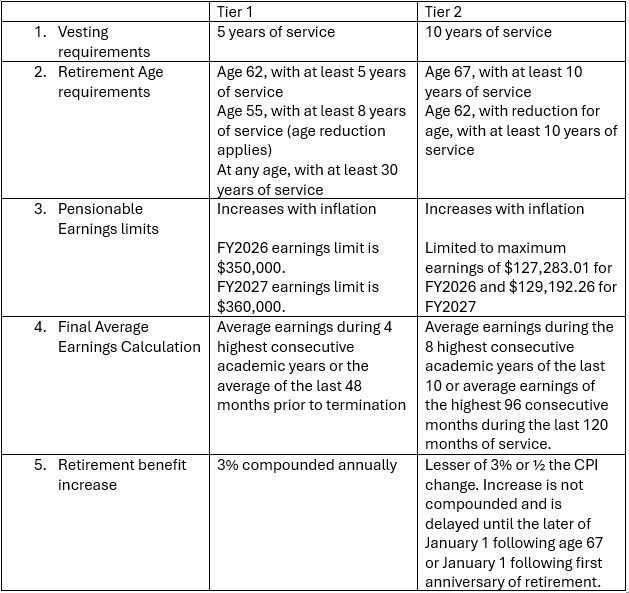
To begin, let’s discuss the qualifications for retiree health insurance benefits. The first requirement is service credit. Service credit can vary based on your SURS membership Tier, which is determined by the date of first employment under a SURS covered employer. For anyone with service credit prior to January 1, 2011, you are considered a Tier I participant. A Tier I participant is eligible for retiree insurance benefits after 5 years of service credit. Anyone beginning service credit on or after January 1, 2011 is a Tier II participant. 10 years of service credit is required for Tier II participants to be eligible for any retiree health insurance benefit.

The service credit discussed above is the minimum requirements to be eligible for retiree health insurance. Meeting the minimum service credit requirements only provides for a subsidy of the cost of this benefit. To have your insurance fully subsidized by the State of Illinois, you need 20 years of service credit. Members who meet the minimum coverage requirements and have less than 20 years split the cost of coverage with the state. The chart below summarizes this cost split:

Costs above are for the employee only. Coverage for a spouse or dependents is available for an additional cost.

Annuity Election

The second requirement in addition to meeting the service credit requirements to qualify for retiree health insurance is to annuitize your pension. If you separate from service and defer taking a monthly retirement benefit under SURS, you would not be entitled to the retiree insurance benefit until you have annuitized your pension plan. Taking a refund of your pension plan balance, including rolling over your plan balance to an IRA or other retirement plan will result in a forfeiture of retiree health insurance benefits.

Annuitization of SURS is the process of converting your benefit into a stream of income payable monthly for the remainder of your life. For the Traditional and Portable plan, this is fairly straightforward. Your pension is based the higher of two formulas which SURS will calculate for you. Your main decision is whether to select a survivor benefit for your spouse or a qualified dependent.

The Retirement Savings Plan has more flexibility, which makes annuitizing a bit more complex. Here is a summary of your options.

1.    Annuitize the entire balance of your SURS RSP. This annuity will generally be administered for SURS through Principal Insurance company, or at TIAA if you still have funds in your RSP portfolio invested at TIAA.

2.    Move at least 50% of your RSP portfolio balance into the SURS Secure Income Portfolio and activate the lifetime income benefit. When selecting this option, all RSP investment funds not otherwise annuitized must be first moved into the Lifetime Income Strategy (LIS) portfolio. Next, with all non-annuitized RSP funds in the LIS portfolio, at least 50% of those LIS funds must then be moved into the SIP with its guaranteed income benefit. After moving all funds into the LIS and activation of at least 50% of your LIS fund total into the guaranteed SIP, any LIS funds not in the SIP may be moved back to RSP Core Funds or withdrawn.

3.    A combination of Options 1 & 2 – for example, you could use 1/3rd of your RSP account to buy an annuity through Principal. With the remaining RSP balance, allocate 50% to the SIP for lifetime income and 50% to the LIS or Core Funds for periodic withdrawal.

We have commonly heard the misconception that RSP participants must use the new SIP to maintain health insurance, which is not true. Electing an annuity remains an option.

Timing of Retiree Health Insurance

It is possible to retire from the University and delay drawing your pension. This may be beneficial if you have alternative insurance coverage through new employment or a spouse. Deferring your benefit has two potential benefits. First of all, your pension benefit (traditional or portable) may increase or the balance of your account can continue to grow (RSP). Secondly, if you are not yet Medicare-eligible, the State of Illinois will pay an additional monthly incentive to opt out of retiree insurance.

Example 1

A University Employee has 20 years of service at age 50, at which point she leaves university employment to pursue a second career with a private sector employer. The new employer offers health insurance. The employee leaves her account balance with the SURS RSP, which allows the balance to continue to grow. At age 63, she fully retires from her private sector position and needs health insurance. At this point, she activates one of the RSP income options to qualify for health insurance as a State of Illinois retiree.

The Value of Retiree Health Insurance under SURS

There may be cases where an individual chooses to forgo their SURS retiree health insurance benefits, but before making this irrevocable decision, it is important to understand what those health insurance benefits are worth.

How SURS Retiree Health Insurance works with Medicare

Those in the SURS RSP are also required to participate in Medicare. While working, everyone pays into the Medicare system. Upon turning age 65, you must sign up for Medicare. If you are still working and covered by your University insurance, you only need to enroll in Medicare Part A, but may delay Part B until you retire.

Medicare has three parts:

  • Part A, which covers Hospital services and is generally free for those age 65+

  • Part B, which covers doctor visits and other outpatient services. Part B has a monthly premium starting at $170.10 (2022); cost can increase based on income.

  • Part D, which covers prescription drug costs

Once you retire and become a SURS annuitant aged 65 or older, you are required to enroll in the Total Retiree Advantage Illinois (TRAIL) plan, managed through Illinois Central Management Services (CMS). This is a Medicare Advantage plan, which means it combines Medicare Part A, Part B, Part D and a Medicare Supplemental Policy (commonly known as a Medigap policy). Even under the TRAIL program, you still must pay the Medicare Part B premiums on your own. The State of Illinois subsidizes (or entirely covers) the rest of your supplemental health cost.

How much is this SURS health insurance subsidy worth? 

For a retiree with 20 or more years of service, age 65 or older and on Medicare, the value of this benefit is around $150 per month. This is based on the amount the State of Illinois covers for the cost of the Advantage Plan (Illinois Central Management Services, 2022).

For a retiree with 20 or more years of service and under the age of 65, the SURS health insurance benefit is significantly more valuable. Prior to Medicare eligibility, the State picks up the entire cost of their health insurance. For those retiring before age 65, the cost of health insurance can be a significant obstacle.  For example, marketplace plans at healthcare.gov range in cost from $1,165 to $1,791 for a 60 year old male in the Champaign County area.

Conclusion

Health Insurance is one of the biggest obstacles we see for clients who wish to retire prior to eligibility for Medicare at age 65. If you are retiring early from the University, it could be a valuable benefit. The requirement to annuitize is the biggest obstacle, especially for those in the SURS Retirement Savings Plan. Once you are Medicare eligible, the value of the insurance benefit is less valuable as Medicare covers a significant portion medical expenses and Medicare supplement policies are low in cost as compared to private health insurance.

Update on Illinois Retiree Insurance

We have heard from many of our clients regarding concerns over the change in Insurance Providers for State of Illinois Medicare-Eligible Retirees. With so many clients impacted by this change, we have been following the news. Here is what we know so far and what we are recommending.
 
Starting with what we know, it is not much. We wrote up a short piece on our website on this a few weeks back, which you can read here. The major concern at this time is that Carle has not come to an agreement with the Advantage Plan Provider, Aetna. This means that Carle providers and facilities are not in-network for the new plan effective January 1, 2023. While the new plan is a PPO and should allow you to see out-of-network doctors, these services may not be covered if the provider is unwilling to bill through Aetna.
 
As far as we can tell, conversations between Carle and Aetna are ongoing and there is a possibility that an agreement will be reached before the new plan year. This would not be unprecedented. A similar process unfolded about 10 years ago when Health Alliance was dropped in favor of UnitedHealthcare. Recent comments from Carle and Aetna representatives may be more attempts to rally public pressure for negotiations than statements of actual status of negotiations.
 
The unfortunate part is this leaves a lot of uncertainty for current plan participants. Here is what we are recommending:
 
If you are currently undergoing treatment for chronic or critical medical issues and absolutely cannot switch doctors, be prepared to switch to a private policy:

  • November 30th – Deadline to opt out of the TRAIL / State of Illinois Medicare Plan

  • December 7th – Deadline for Medicare Open Enrollment to select your own private plan

  • Research Alternative Plans - Medicare's Website is the best resource as you can narrow in to providers covered in your area.

    • Private policies generally run $50-175/month/person, but can be higher or lower depending on deductible, co-pays, etc.

    • Inputting your current prescriptions will provide you a better total out of pocket cost estimate.

    • Pay attention to vision and dental coverage.


For everyone else, it is probably best to take a wait-and-see approach. If Carle and Aetna reach an eleventh hour agreement, you avoid all the hassle of unenrolling and reenrolling from TRAIL next year. If they do not reach an agreement, you could also unenroll from TRAIL during the next enrollment period near the end of 2023.

Insurance Changes for Illinois State Retiree Health Insurance

In September, the State of Illinois Department of Central Management Services (CMS) announced changes to the State of Illinois Retiree Insurance Program. These changes impact retirees enrolled in the Total Retiree Advantage Illinois (TRAIL) who are also Medicare Eligible. This applies to members who are currently enrolled, or plan to enroll in the TRAIL Medicare Advantage Prescription Drug (MAPD) plan effective for the 2023 plan year.

Following a proposal process, the State of Illinois has selected Aetna Medicare Advantage Prescription Drug (MAPD) PPO Plan as the new medical and prescription drug plan beginning January 1, 2023. This will replace the existing plans, most commonly the HMO Plans through UnitedHealthcare, Health Alliance, or Humana. This change is automatic and does not require participants to take any action .

Here are a few Frequently Asked Questions (FAQs) that may help you:

Why is this change happening?

The contract with current providers expires December 31, 2022. State law requires a competitive process to compare proposals submitted by various vendors. Aetna was selected as part of this process.

With any change in insurance provider also comes concern over coverage of existing doctors and hospitals. While it is yet to be seen how these concerns will be addressed, it is worth noting this is not a new process. A similar process unfolded when Health Alliance was dropped in exchange for UnitedHealthcare.

Can I maintain my current Medicare Advantage Plan Provider?

No. To maintain coverage under the Total Retiree Advantage Illinois (TRAIL), including subsidized premiums under your retirement annuity, you and your dependents will automatically change to the new provider.

You may opt of out of TRAIL by visiting MyBenefits.illinois.gov. This must be completed by November 30, 2022. If you opt out, you will want to select a new Medicare Supplement and Part D or Medicare Advantage plan in the private market. You will be responsible for the full premiums for these Supplement/Advantage plans. You can compare plans at Medicare's Website. If you opt out, you may re-enroll in the TRAIL program with a qualified life event or during the next year’s open enrollment.

What if I am not Medicare Eligible?

This change only impacts members and their dependents whose coverage is under a Medicare Advantage plan. If you or any dependents are not Medicare-eligible, your coverage is through the State Employees Group Insurance Program (SEGIP) and is not impacted by this change. This change may impact you if you become Medicare eligible in the future.

What is a Medicare Advantage Plan?

Medicare is commonly made up of three parts:

  •          Part A – Covers Hospital Services

  •          Part B – Medical Insurance

  •          Part D – Prescription Drugs

Most Medicare participants also add a Medicare Supplement plan to cover any gaps and add services above the base Medicare plans.

Medicare Advantage Plans combine all the above plans into a single plan, administered through a private health insurance company. In this case, Aetna is the private company who will take over administration.

Do I pay Medicare Premiums if I am enrolled in a Medicare Advantage Plan?

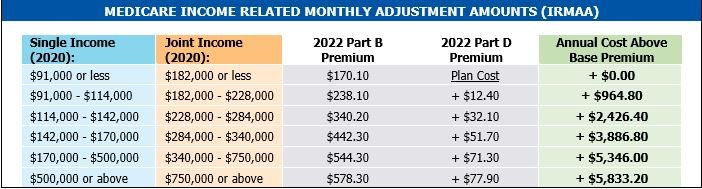
Yes. While a Medicare Advantage plan replaces original Medicare, you are still responsible for Medicare Part B premiums, which are either paid directly to Medicare or deducted from Social Security benefits. Note that, for most people, Medicare Part A is free (paid through Payroll taxes while working). Your Part B premium is based on your income and can change from year to year. Part D may also have a supplemental cost. These premium adjustments are called the Income Related Monthly Adjustment Amounts (IRMAA) as follows:

What’s Next for Me?  

As mentioned previously, for those opting out, actions will need to be taken. For those choosing to stay on the TRAIL MAPD program, the change is automatic for members and their dependents. You will receive a welcome kit in the mail from Aetna with more information on the plan and new member ID Cards. With all the Medicare spam mail that gets sent out, keep a sharp eye out for any correspondence from AETNA, CMS, or anything with the TRAIL logo.

Further Reading and Sources:

Selecting the Right SURS Plan for You

Abstract

Selecting the right Pension Plan under SURS is complex. Below are some of the factors we discuss and a summary of how they may impact your decision:


Traditional Plan

Portable Plan

Retirement Savings Plan

High-income Participants

Less Favorable

Less Favorable

More Favorable

Participant Control of Investments 

No

No

Yes

Pension Income Guaranteed

Yes

Yes

No

Career Stage

Favors Late-Career

Favors Late-Career

Favors Early-Career

Flexible Options at Retirement

Least

Moderate

Most

Introduction

Congratulations on your new role with an Illinois public institution! In addition to meeting your new colleagues, learning the ropes of your new department, and developing your new courses (if instructing), you will need to select a pension plan under the options offered through the State Universities Retirement System (SURS). Choosing the right plan can be complex, so we have narrowed down the factors we have found make the biggest difference.

We encourage you to be diligent in your selection process, but do not delay! While you have 6 months to select a plan, matching contributions are not allocated to the self-directed plan until you decide. If you fail to decide, you will automatically be enrolled into the default option of the Traditional Plan.

So, let’s get started!

An Overview of the Options

When you begin employment, you must select from three plan offerings: TraditionalPortable, or Retirement Savings Plan (hereafter referred to as RSP). The RSP was previously known as the Self-Managed Plan (SMP) until it was updated and rebranded in 2021. You may find that some colleagues still refer to it as such.

While all three plans are considered pension plans, they can be distinguished at a high level between defined benefit and defined contribution plans. In a defined benefit pension plan, your retirement income is based on a formula. The Traditional and Portable plans fall under this category. In this case, your income at retirement is determined by your average earnings and length of service. The pool of money that backs this pension is managed by SURS and the investment risk is borne by the State of Illinois.

In contrast, the RSP is a defined contribution plan. Your future retirement income is based on the balance of your account at retirement. Your contributions along with matching contributions from the state are deposited into a separate account for your benefit. You are responsible for selecting and managing the investments in that account and bear the investment risk of that account. When you retire, you can convert that account balance into a stream of income called an annuity. The level of this benefit will be determined by the balance of your account at retirement. You can read about these annuity options in the white paper we wrote about this plan by clicking here.

Options

Plan Type

Summary

Traditional Plan

Portable Plan

Defined Benefit

Retirement benefit based on formula

Employer bears investment risk

Retirement Savings Plan

Defined Contribution

Retirement benefit based on account balance


You bear investment responsibility and risk

How Salary Impacts your Choice

One major difference in the plans is the level of income counted towards your pension benefits. Due to this difference, salary and future growth potential could be the single biggest factors to consider in selecting your plan.

The Traditional and Portable plans are limited to a state-determined Maximum Pensionable Earnings, currently $116,470.42 (Fiscal Year 2022). If your salary exceeds this limit, your contributions to the plan (8% of salary) and employer matching contributions (7.6% of salary) will only be based on your wages up to the limit. Similarly, your final average salary to determine your annual pension will be capped based upon this same limit.

The RSP uses a federal limit for Maximum Pensionable Earnings, currently $290,000 (Fiscal Year 2022). This makes the RSP more favorable to those whose current or future salary may exceed the annual Traditional and Portable annual wage limit. To illustrate, consider the following examples.

Example 1 – Pension Under Traditional Plan

Dr. Zhao has been recruited by the University of Illinois as a Professor and a starting salary $200,000 per year. She selects the SURS Traditional Plan. She works for 25 years, retiring at age 67. Her pension is $64,000/year[i] or $5,333/month.

Example 2 – Pension Under RSP

Let’s assume the same base facts as example 1, except Dr. Zhao selects the RSP plan. She invests her RSP Account Balance into a portfolio of 40% Bonds and 60% Stocks, earning an annualized return of 9.4% per year[ii]. At age 67, she retires with a SURS RSP Balance of $2.8 million. She then annuitizes this balance and receives a lifetime income stream of $142,000/year or $11,833/month[iii].

There is a crucial difference between Examples 1 and 2. As an employee, your contribution to SURS ends after your income exceeds the Maximum Pensionable Earnings. Consider the following table to illustrate:

Plan

Maximum Pensionable Earnings

Contributions Assuming $200,000 Salary

Traditional Plan

Portable Plan

$116,470.42

Employer: amount required annually based on actuarial formula


Employee: $116,470.42 x 8% = $9,317.63

Retirement Savings Plan

$290,000.00

Employer: $200,000 x 7.6% = $15,200


Employee: $200,000 x 8% = $16,000

This means Dr. Zhao would contribute over $6,682.37 ($16,000 - 9,317.63) more per year to the SURS RSP than the SURS Traditional Plan.

Example 3 – Supplemental Savings

Assume the same facts as Example 1, except Dr. Zhao chooses to add the $6,682.37/year to a supplemental retirement savings plan (403b). We will also assume the same hypothetical portfolio used in Example 2. At the end of 25 years, she has an account balance of about $600,000. Assuming the same annuity rates as Example 2, she could receive an estimated additional income of $30,000/year, or $2,500/month, from her 403b account.

Together, these three examples illustrate the impact the salary cap has on the outcome. For someone whose income exceeds the salary cap, selecting the Traditional or Portable plan results in the missed opportunity to receive matching contributions.

Investment Control

For those who choose the RSP, one feature of the plan is the ability to control investment decisions. Voya is the current plan custodian. Through their platform you can allocate your account balance between a mix of different investment choices. One option is to select a custom mix of Core Funds. Core Funds are a set of low-cost, index funds designed to track a variety of investment benchmarks. Participants can choose a custom combination of Core Funds in proportions that they deem most appropriate for their situation, but are self-responsible for managing the balances between the Core Funds over time. An alternative to the Core Funds is the Lifetime Income Strategy (LIS) Fund. The LIS is an investment fund that is managed to automatically adjust the risk level of the fund based on your planned retirement date.

As illustrated in the above examples, choosing the RSP provides participants with the potential for maximizing pension payments in retirement. However, the downside is that you also bear the investment risk that comes along with your investment selections, which, depending on market and investment performance, can directly impact the future balance of the RSP and thus, the size of the pension payments which can be generated by that RSP balance.

If you prefer to have the employer retain the investment risk and receive a guaranteed income, then the Traditional or Portable may be a more suitable option.  These plans are professionally managed by the investment staff with SURS.  No matter the outcome of investment performance, your ultimate pension benefit is guaranteed.

While investment returns in the future cannot be predicted based on past performance, historical data generally shows more favorable returns for those who are invested for a long period of time[iv]. This suggests someone entering employment earlier in their career could benefit from a long period of time to allow investments to compound and grow in value, which may favor the Retirement Savings Plan.

Someone nearing the end of their career may not have a long-time horizon to ride out the ups and down of investment performance. In that case, a new employee in their later working years may favor enrolling in the Traditional or Portable plan.

Vesting & Flexibility

The trend has been toward a more mobile workforce, where multiple job changes throughout one’s career are not uncommon. Academia is not immune to this trend. Therefore, you should consider the flexibility and portability of benefits in the event of an employment change. Here is a summary:

The Traditional plan has the least flexibility for departure or refund. 

  • Requires 10-years of service credit to vest.

  • If you are fully vested and leave SURS-covered employment, you can:

    • Wait and draw benefits at full retirement age, or

    • Take a refund of your own contributions plus interest. Employer matching contributions are forfeited with this choice.

  • If you are not yet vested and leave SURS-covered employment, you are only entitled to a refund of your own contributions. Employer contributions are forfeited unless you later vest.

The Portable plan offers some benefits of the defined-benefit plan while maintaining some flexibility in case of departure.

  • Requires 10-years of service credit to vest.

  • If you are fully vested and leave SURS-covered employment, you can:

    • Wait and draw benefits at full retirement age, or

    • Take a refund of your contributions, employer matching contributions, plus interest.

  • If you are not yet vested and leave SURS-covered employment, you are only entitled to a refund of your own contributions. Employer contributions and interest are also refundable after 5 years of service credit.

The Retirement Savings Plan offers the most flexibility.

  • You vest with 5 years of service credit.

  • If you are fully vested and leave SURS-covered employment, you can take a refund of your contributions, the employer contributions, and growth and interest of the account.

  • If you are not fully vested and leave SURS-covered employment, you can take a refund of your contributions and growth and interest of the account. Employer contributions are forfeited.

For all plans, eligibility for retiree health insurance requires you to fully vest. Taking the full refund option for any pension will forfeit retiree health insurance benefits.

Survivor & Legacy Benefits

In exchange for reduced flexibility, the Traditional plan offers the most generous survivor benefits. Survivors would receive 2/3rds of your accrued monthly retirement benefit, payable to your eligible survivor.  This benefit comes at no extra cost to you. 

Example 4 – Survivor Benefits, Traditional

Following the same facts as example 1, assume that Dr. Zhao had selected the SURS Traditional pension with a base benefit of $5,333/month. If she were to die shortly after retiring, her spouse would be entitled to a survivor benefit of $3,555/month for life. At the death of Dr. Zhao and her spouse, no additional survivor benefits would be payable to children or other heirs.

The Portable plan only offers a default survivor benefit if you die before reaching retirement.  In that case, the benefit is 50% of your accrued retirement benefit (as compared to 2/3rds under the Traditional plan).  Upon retirement, you can choose to purchase a survivor benefit greater than 50% at a cost to you of reduced lifetime payments.

Example 5 – Survivor Benefits, Portable

Following the same facts as example 1, assume that Dr. Zhao had selected the SURS Portable pension with a base benefit of $5,333/month. If she were to die shortly after retiring, her spouse would not be entitled to any survivor benefit. At retirement, Dr. Zhao could instead choose to take a reduced monthly pension to add a survivor benefit for 50%, 75% or 100% of the original pension.

The RSP does not provide an automatic lifetime survivor payment.  You or your survivor are always eligible for a refund of your own contributions and earnings. After 1.5 years of service, employer matching and related earnings are also refundable to survivors.  Your survivor may choose a lifetime payment with this refund, with the amount of such payment based on your account balance at that time.

FINAL NOTES

This guide was written for those enrolling in SURS now and are therefore in Tier II SURS plans. This applies to those enrolled on or after January 1, 2011. If you first enrolled in SURS prior to this date and are a Tier I participant, some of these plan provisions may be different.

I’ll note that many clients consider the RSP a refuge from the troubled finances of the State of Illinois. The idea is that funds are held separately, in-trust, and therefore safe from the creditors of the State. This is true. By federal law, RSP funds must be deposited in a timely manner to your account, including employer matching.  State matching of the other pension plans has not always been made timely, which is a big part of the pension underfunding problem.

However, this advantage of the RSP does not make the Traditional or Portable plans “unsafe”.  The Illinois constitution states that pension benefits cannot be diminished, which guarantees participants their right to future benefits.  Previous attempts at pension reform have tested and found this guarantee to be true.  Unlike municipalities and territories, Detroit and Puerto Rico being recent examples, a State may not go bankrupt and therefore discharge the indebtedness of pension through bankruptcy.  While it is yet to be seen how the state will solve its current financial crisis, it must pay the promised bill of pensions. 

Regardless of whichever plan you choose, I would also encourage you to fund additional savings beyond your mandatory pension contributions.  While the SURS system does provide generous pension benefits, the pension was not designed to cover all your needs beyond working years.  Additionally, depending on your work history, you may not qualify for social security benefits as you do not participate in the social security system while actively participating in SURS.  Even if you have a past earnings history in social security, your social security benefits may be reduced as a result of the benefits you earned while participating in SURS.  While there are many savings options out there, the 403b and 457 savings plans offered through the University are often a good place to start.  We generally recommend supplemental savings of at least 7% and ideally 10% of earnings beyond your required SURS contributions. 

CONCLUSION

Navigating this initial decision on retirement plan choice will have a lasting impact on your future financial security.  Compounding the importance of this decision, it must be made in the flurry of other important activities of moving, starting a new job, selecting other benefits and adapting to your new role.  If you need help interpreting these decisions in your own financial life or want the peace of mind that you have considered the entire picture, please let us know.  Many of our clients are members or retirees of SURS.  We have helped hundreds of clients through the complexities of pension decisions.  If you would like our perspective or professional opinion on your own decisions, Contact Us today!

Further Reading

SURS Traditional - SURS Traditional Guide

SURS Portable - SURS Portable Guide

SURS Retirement Savings Plan - SURS RSP Guide

Sources

[i] Calculated using the General Formula: 2.2% x 25 Years of Service x the maximum pensionable earnings limit of $116,470.42. Result rounded to the nearest thousand for simplicity of reading. There is a second formula called Money Purchase formula based on investment returns that may result in different pension calculation. We used the General Formula because your benefit can never be less than this result.

[ii] Investment Returns based on Shea, B. (2021). Investment Returns since 1926-2021 from Ibbotson's SBBI.

[iii] Future account balance calculated on investment return as described above and is not guaranteed. Past performance does not predict future results. Annuity calculated using a 50% Joint and Survivor Annuity Rates for 65-Year-Old Annuitant and 60-Year-Old Spouse as provided by Principal Life Insurance Company, Illustrative Table of Annuity Premiums for SURS Rates as of Jan. 1, 2021

[iv] How risk, reward & time are related (2022). Vanguard. Risk, reward & compounding | Vanguard 

This post was updated August 2022.

SURS Self-Managed Transitions to SURS Retirement Savings Plan

SURS Self-Managed Transitions to SURS Retirement Savings Plan

Effective September 2020, big changes will be happening to the SURS Self-Managed Plan (SMP), transitioning to the new SURS Retirement Savings Plan (RSP). We have summarized the change and the implications for participants and their investments.