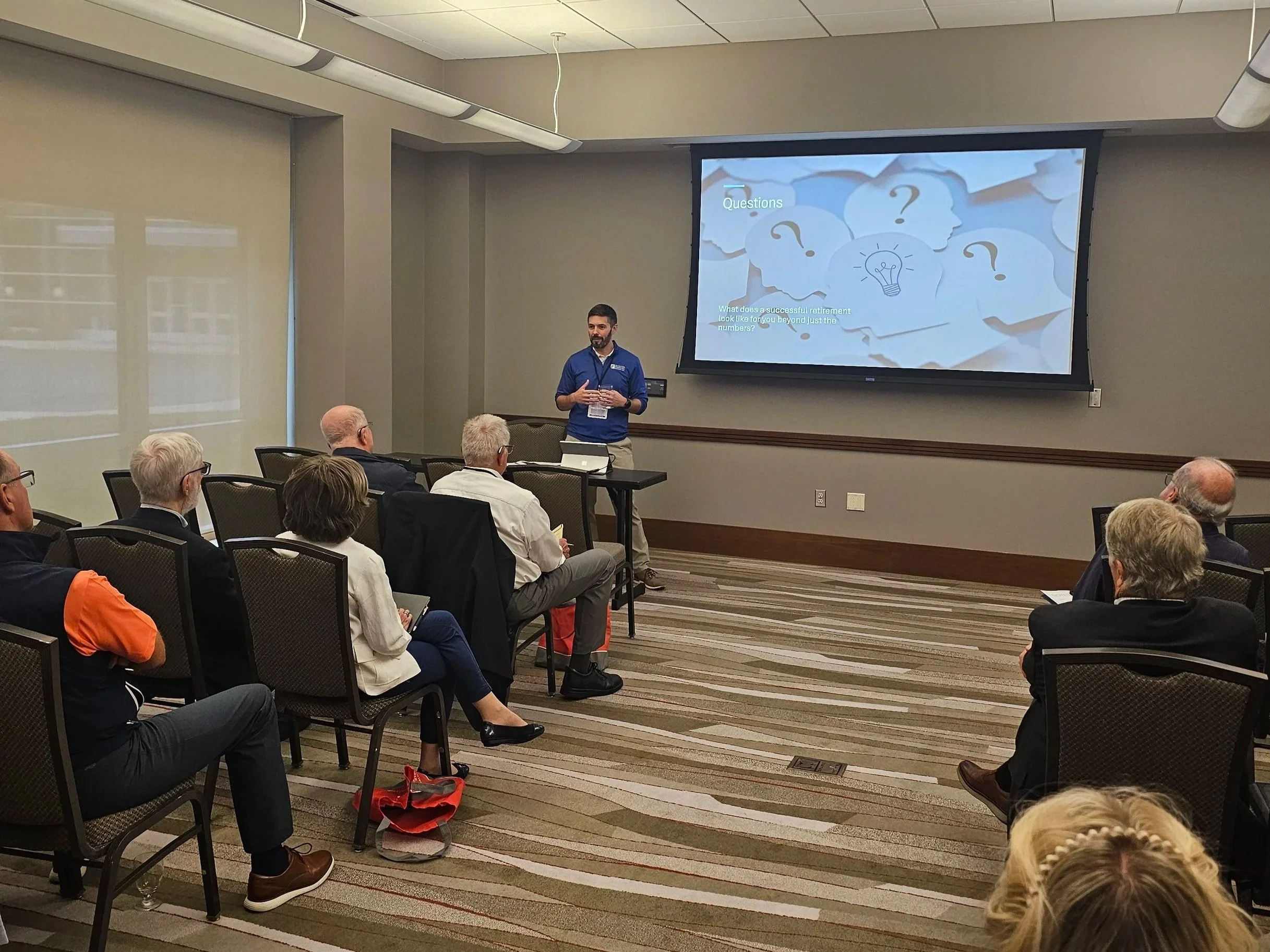
In late 2025, the University of Illinois rolled out a new Faculty Phased Retirement Program (FPRP). This program offers tenured and other select faculty a way to build a glidepath into retirement while maintaining access to health insurance and other employee benefits. This guide offers our clients and those interested in this program an overview of the program as well as considerations for your retirement and financial plan.
Introduction to the FPRP
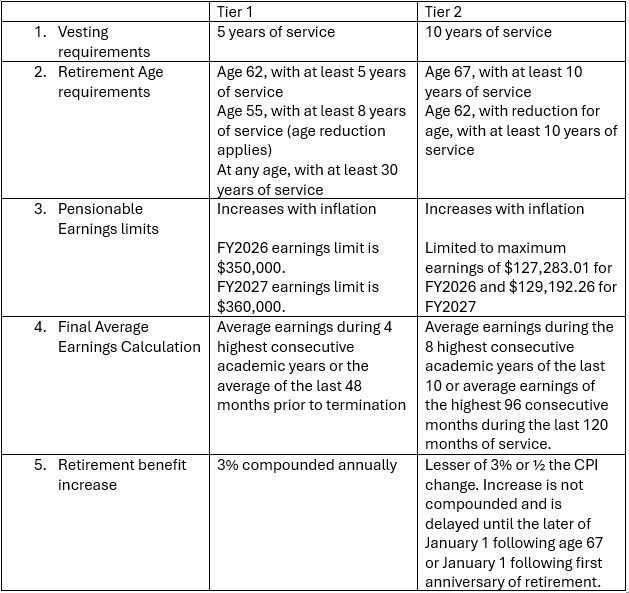
To qualify for the program, you must be tenured or specialized faculty at UIUC who will otherwise be eligible for retirement under the State University Retirement System (SURS) by the end of the 3-year program. Here is the eligibility for retirement under SURS (State Universities Retirement System, 2025a):
SURS Retirement Savings Plan, or Tier 1 Traditional / Portable - Age 55 with 8 Years of Service Credit, Age 62 with 5 Years of Service Credit, or any age with 30 Years of Service Credit.
Tier 2 Traditional or Portable participants - 10 Years of Service Credit at age 62.
Once accepted by your leadership and Dean, your appointment can be phased down over a period of up to three years. This allows you to stay involved in a part of your position you enjoy such as teaching, research, or supervising graduate students, and give up parts of your position you wish to reduce or eliminate. (Illinois Human Resources, 2025)
Impacts with your Pension and Retiree Health Insurance
It is important to understand this program does not change any of your elections within SURS or elect retirement under SURS. This reduces your appointment with UIUC with an agreement to fully retire by an agreed upon date. While health insurance is subsidized during this transition period, your retirement pension and health insurance benefits may be impacted.
SURS Traditional and Portable
Whether you are Tier 1 or Tier 2, your retirement benefits are determined based on a formula that factors in your years of service and final average salary. By opting into this program and reducing your appointment, you may accrue less service credit.
Example 1:
Sally is a 62-year-old professor in SURS Traditional that planned to work until age 65. She is interested in the FPRP program to see her graduate student through completion of his PhD as well as finish out her current grant funded research project. She currently has 17 years of service credit.
If she did not elect FPRP, she would accrue 3 more years of service credit and retire with 20 years at age 65. Assuming final average earnings of $150,000 and using the 2.2 rule, her pension would be $66,000 per year ($150,000 x 2.2% x 20). (State Universities Retirement System, n.d.)
If she elected FPRP, with a 66% appointment through age 65, she would only accrue 2 years of service credit over the final 3 years, ending with 19 years of service credit. Assuming Final Average Earnings of $150,000 and using the 2.2 Rule, her pension would be $62,700, a reduction of $3,300 per year.
Keep in mind, many of our faculty clients have additional sources of salary while working in a full-time appointment, such as drawing summer salary or salary supplements for leadership roles. If you were to give up these sources of income under the PFRP, you may see other impacts on your final pension calculation. These impacts would need to be calculated at the individual level as it can vary based on your final average salary and considering impacts of cost-of-living adjustments you may be entitled to if you retire earlier.
SURS Retirement Savings Plan
This pension plan determines benefits based on contributions and investment growth on the plan rather than years of service. By opting into this program, your salary would be reduced and therefore your own contributions and matching by your employer would be reduced.
Example 2:
Same facts as Example 1, except Sally is in SURS RSP. Sally contributes the mandatory 8% of her income to RSP and her employer matches this with 7.3% for total contributions of 15.3%.
Over the next 3 years and working full-time, her SURS RSP would receive contributions of $68,850 ($150,000 x 15.3% x 3).
If instead, she opts into the FPRP, her SURS RSP would receive contributions of $45,441 ($150,000 x 66% x 15.3% x 3) .
The exact impacts on retirement income are unknown as we cannot predict future investment returns or annuity rates. In either Example 1 or 2, Sally could consider “making up” some of this lost retirement income be increasing her voluntary retirement contributions via the 403b or 457 Deferred Compensation programs. However, this would further reduce her take-home pay beyond reduction in salary.
Health Insurance while Working
One of the primary benefits of the FPRP is the ability to maintain access to health insurance during the program at the same rates you pay during a full-time appointment. Normally, taking a reduced appointment that reduces your full-time equivalency below 1.0 would also come with a prorated increase in premiums to make up for the employer insurance premium subsidy. Under this program, your employer will make up that increased cost on your behalf. The details of these premium subsidies can be found at HR Resources Website - Insurance Impact Scenarios.
Health Insurance in Retirement
Once you complete the FPRP program and fully retire, you may have access to Retiree Health Insurance benefits. Eligibility of these benefits is based on your annuitization of your SURS pension and number of years of service credit. Read more about these benefits and eligibility requirements at Retiree Health Insurance Under SURS: An Explainer.
Notably, if you have less than 20 years of service reducing your appointment may reduce your eligibility for retiree health insurance benefits.
Example 3:
Going back to the facts in Example 1, if Sally does not opt into the FPRP and works until age 65, she will obtain 20 years of service credit. If she annuitizes her SURS pension, her retiree health insurance benefit is fully vested, and she will pay no premiums towards this benefit.
If she does opt into the FPRP and works until age 65 at a 66% appointment, she will only obtain 19 years of service credit. Upon annuitizing her SURS pension, she will be eligible for Retiree Health Insurance Benefits but will be responsible for 5% of the total cost each year. This is because health insurance premiums for retirees are based on number of years of service (State Universities Retirement System, 2025b).
Please note, at age 65, most participants will be required to opt into a Medicare Part A and Part B policy. While Part A generally has no premium when retired, Part B does have a Premium. You are responsible for Part B premiums, which are paid directly to Medicare, regardless of number of years of service credit. Upon reaching age 65, you would enroll in the Total Retiree Insurance Illinois Plan (TRAIL), which is currently a Medicare Advantage plan. The premiums on this are very low and therefore having less than 20 years of service credit has a minimal financial impact with regard to premiums. The impact is much larger for those retiring before age 65 or if Medicare Advantage premiums were to rise significantly later in retirement.
Bluestem’s View
The primary benefit of this program is providing flexibility in transitioning into retirement. We have seen some clients struggle with a sudden retirement, going from working full-time to fully retired. After the initial honeymoon period wears off, some feel a lack of structure and purpose without a longer period of transition. This program can provide a structured way to glide into retirement rather than making the transition from full-time work to retirement suddenly. If the time offered under this program is used to begin building post-retirement interests and purpose, it could be a positive program to consider.
See more on purpose in Money and Happiness Part II: Relationships, Purpose, and Fulfillment.
The maximum length of three years is also a downside of the program. It limits flexibility for those who still want to contribute over the long-term but adapt their work to their skills. Drawing on Arthur Brooks’ central theme from Strength to Strength, as our brains age, our cognitive strengths shift from problem-solving (“fluid intelligence”) to wisdom-based skills (“crystallized intelligence”) such as teaching, mentoring, and synthesizing knowledge. This transition can be a tremendous asset to both the university and the faculty member, as seasoned faculty can offer invaluable guidance, historical perspective, and mentorship to younger colleagues and students. Extending opportunities for experienced faculty to stay engaged beyond a fixed period allows the institution to benefit from these evolving strengths, while enabling faculty to continue making meaningful contributions in roles that leverage their accumulated expertise and insight.
Financial Considerations
The reality is, any decision to retire early is a “net negative” for the balance sheet as you are reducing your capacity to earn income, contribute to savings, and often drawing on savings sooner. That being said, if you are at or nearing financial independence, retirement is an opportunity to trade financial resources for something even more valuable — your time. As discussed above, the FPRP is likely to have some impacts on retirement income, but for many it may be manageable.
A more important consideration is, can you handle the salary reduction during the phased period? As you are not actually retired, you will not be eligible to draw your pension. Additionally, if you are not yet full retirement age for Social Security Benefits (typically 67), continued salary may limit your ability to draw benefits until you are fully retired.
In Summary
The Faculty Phased Retirement Program can offer welcome flexibility and a dignified glide path into retirement. Success depends on aligning your workload, annuitization date, and health insurance timing, subject to securing unit/dean approval. If you’d like a second set of eyes to weigh the trade‑offs and tailor a plan, especially around SURS options, retiree health insurance, and cash‑flow modeling our team is here to help. We’ve helped hundreds of faculty navigate SURS, retiree health insurance, and retirement decisions with clarity and confidence.
Schedule a call for an introductory call to learn more.
Further Reading
Illinois Human Resources. (2025). Faculty Phased Retirement Program. University of Illinois Urbana‑Champaign. https://humanresources.illinois.edu/faculty-phased-retirement-program/
University of Illinois System Human Resource Services. (n.d.). Retirement & Investment Plans. https://www.hr.uillinois.edu/benefits/retirement
State Universities Retirement System. (2025). Retiree Health Insurance and Rates. https://surs.org/benefits/insurance/
State Universities Retirement System. (2025). Retirement Eligibility. https://surs.org/retirement/eligibility/
State Universities Retirement System. (n.d.). Traditional Benefit Package – Guide [PDF]. https://surs.org/wp-content/uploads/Guide-TRD.pdf
Important Disclaimers
This content has not been reviewed by or endorsed by State Universities Retirement Systems - SURS. Bluestem Financial Advisors, LLC, is an independent advisory firm not affiliated with SURS.