Disability Insurance: Covering the Underestimated Scenario

Disability Insurance: Covering the Underestimated Scenario

Regardless of your employer, remember that it is all too common to underestimate the possibility of an extended illness or other event that would make full-time employment impossible. Take a closer look at the disability benefits offered through your employer and consider if additional long-term disability insurance would protect the financial health of your family. 

Finding Your Philanthropic Focus - Guest Blog Post

Finding Your Philanthropic Focus

By Shari Fox, CAP®

Principal, Fox Philanthropic Advisors LLC

Are you interested in using more of your financial resources to help others? Do you want to give more but find it challenging to decide where to donate your time and resources? Do you want to ensure the charitable giving you are already doing has the most significant impact possible? Have you ever felt overwhelmed by the sheer number of charities and causes out there, making it difficult to know where to start?

If you've answered yes to any of these questions, then this blog is for you. We'll explore the steps you can take to narrow your focus in charitable giving, allowing you to make a real difference in the world. Are you ready to learn how to make the most of your charitable donations and help those in need? Let's dive in!

To start, look at the giving you are already doing. You likely compiled receipts from the charitable organizations you supported last year to file your tax return. Or if you have a donor advised fund, maybe you reviewed a summary of your grants for the year. Did you notice anything? Was there a pattern? Did you make a few large gifts to organizations within a particular cause (education, global health, or the environment, for instance)? Or did you make a lot of small to modest gifts all over the place?

First, whichever of the above holds true for you – thank you. Thank you for being generous and caring about your communities, local and global. If those gifts add up to a substantial portion of your income or wealth, though, particularly if the total is large enough for you to itemize deductions, you have an opportunity to be intentional about making a difference.

Think about that for a minute. What change would you like to make in the world? Seriously. What would you like to accomplish with your money that would be meaningful to you?

If you’ve never taken the time to determine your philanthropic focus, start by reflecting on your motivations for giving.

⠀⠀⠀⠀⠀⠀⠀⠀· Why do you give? Is it in response, or is it to create?

⠀⠀⠀⠀⠀⠀⠀⠀· What do you hope to gain from your giving?

⠀⠀⠀⠀⠀⠀⠀⠀· What do you want to sustain in the world?

⠀⠀⠀⠀⠀⠀⠀⠀· What do you want to change in the world?

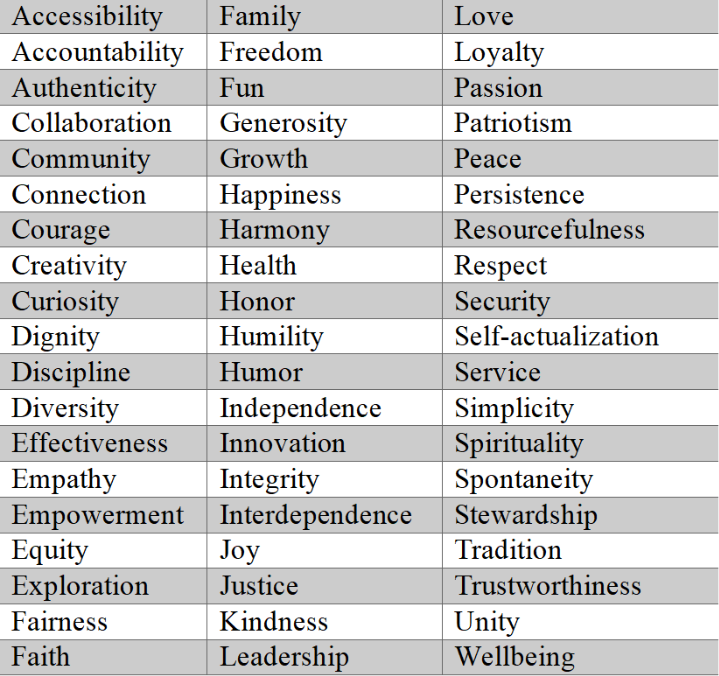
Write down your answers. Then, reflect on your core values. Here are some possibilities.


Try to narrow it to three from this list, five tops. Write them down. Are they reflected in your charitable contributions? Review that stack of receipts from charitable organizations, the one you compiled for your tax return. Is there an opportunity for you to establish a philanthropic plan that more intentionally aligns with your core values?

Identifying your philanthropic focus can make giving less reactionary and more meaningful. It's crucial to uncover your motivations for charitable giving to make sure that your donations have a more significant impact. I had the pleasure of getting to know a woman who did just that. She turned 100 recently, and we sat down to discuss her reflections on a lifetime of philanthropy. She told me that since she was a young adult, she has always been open to giving to community needs. As she became more experienced as a donor and volunteer, though, she realized how much her childhood experiences and her access to a good education, particularly a college degree, had influenced her life as an adult. With that in mind, she began to focus her dollars and her time in the areas of women and education, particularly in her local community. Her primary areas of support include programs that help women advance their education and employment opportunities.

Through her volunteer efforts, she also saw that many children did not have opportunities to interact in productive ways outside of the classroom, and that the only way many of them knew students of other schools was as rivals on the playing field or court. She decided that in addition to programs that help women achieve their personal goals, she would prioritize developmental and social programs that bring together children and teens from different backgrounds, believing that when combined with a good foundational education, these would help them grow into healthy, engaged citizens.

These areas of emphasis would, in this philanthropist’s thinking, improve lives and contribute to the betterment of society as a whole.

Another couple with whom I’ve worked had a particular interest in leadership development, as they had each risen to positions of prominence during their careers. This, too, is a broad category, so they spent time discussing where and how they wanted to have an impact. They landed on supporting student leadership programs at their alma maters, funding leadership development retreats and programs to bring back successful alumni for multi-day residencies. In addition, they funded an academic research project to determine the impact of one university’s student leadership programs on its alumni success, thereby informing the efficacy of their contributions and others’.

These are simply two examples of donors being intentional about their philanthropic focus. There are many others, whether they be healthcare, medical research, animal welfare, the arts, environmental sustainability, mental health – the list is long and the need for investment is great. Like other worthy endeavors, doing philanthropy well takes some work. The rewards, however, can be beyond measure.

This post was guest written by Shari Fox of Fox Philanthropic Advisors. If you would like to delve deeper into your personal or family philanthropic mission and practice, contact me at sharifox@foxphilanthropic.com for an exploratory conversation. The first one is on me.

The team at Bluestem believe that charitable giving can play a crucial role in helping our clients achieve a more fulfilled life. If you're interested in incorporating charitable giving into your tax and financial plan, we would love to help. Here is how to connect and learn more.

Fox Philanthropic Advisors LLC Disclaimer: This information is not intended as legal, tax, or financial planning advice. Readers should consult with their own professional advisors before making any charitable gift.

Navigating Benefit Decisions During the University of Illinois Urbana-Champaign’s Open Enrollment

Navigating Benefit Decisions During the University of Illinois Urbana-Champaign’s Open Enrollment

In this blog, I’ll share with you some thoughts to help blast through the barrage of benefit choices, cutting to the core of what’s important to think about when making decisions during the University of Illinois at Urbana-Champaign’s benefit Open Enrollment for eligible full-time employees.

Making Sense of Medicare IRMAA, a Universally Confusing Topic

Making Sense of Medicare IRMAA, a Universally Confusing Topic

The forename Irma is of Germanic origins and means “universe.” For many retirees, Medicare IRMAA is of universally confusing origin. In this article we’ll cut through some of the bewilderment, and hopefully leave you with a sounder understanding of IRMAA’s purpose, calculation, and planning opportunities.

Alert for University of Illinois Employees: Open Enrollment for Supplemental Long-Term Disability Benefits through March 10, 2023

Alert for University of Illinois Employees: Open Enrollment for Supplemental Long-Term Disability Benefits through March 10, 2023

Disability insurance is often overlooked and, in many cases, more important than life insurance. This is something that we stress with our clients when reviewing their risks and insurance needs. Open Enrollment for Supplemental Long-Term Disability Benefits through March 10, 2023!

Four Considerations When Retiring with SURS Retirement Savings Plan

Introduction

To be or not to be, that is the question. A binary choice. In the past, a SURS Self-Managed Plan (SMP) participant once had a binary choice like this. Annuitize or not annuitize. Annuitization would ensure a lifetime stream of income and the retiree health insurance. By not annuitizing, or taking the lump sum option, one was turning down the health insurance and assuming the risk of portfolio management.

Along with the rebranding of the SMP to the SURS Retirement Savings Plan (RSP), more choices were added. With more choices comes more complexity. Participants may still choose to annuitize the lump sum as they have in the past. Alternatively, one may choose to use the new Secure Income Portfolio (SIP). Some of the new benefits SIP affords are:

1) the potential to have one’s retirement income stream increase with market returns, and

2) the ability to leave the residual value of one’s SURS account to heirs at death.

Along with these new choices come more options. One new choice is the ability to only use half of the account to produce guaranteed income and still maintain state-provided health insurance. This ability provides guaranteed income through the Secure Income Portfolio (“SIP”). The remaining 50% would be kept in the Lifetime Income Strategy (“LIS”) and can be accessed as needed.

To review a more comprehensive explanation and analysis of the new RSP, you can download a whitepaper we authored here.

What we have learned

As we have begun to assist clients through the retirement process since the change from SMP to the new RSP Plan, here are a few items we have learned along the way.

Retiring before age 60

There are different rules for participants retiring before age 60 when using the SIP.

If you choose to have some balance remain in LIS and not be subject to the guaranteed payout through the SIP, you can’t access the amount in the LIS until you turn age 60. One benefit of using the SIP is that you can choose to only use half the account for generating pension income and still qualify for the health insurance benefit. After age 60, the other half – the LIS half – can be used or withdrawn as desired. However, prior to age 60 that freedom to withdraw the account does not apply.

If you retire before age 60, your SIP benefit cannot yet increase with market increases – it is “locked” until age 60. Just like at age 60 and later retirement, the benefit amount may not go down. The “floor” is set at retirement. Once one reaches age 60, benefit increases due to market gains can be granted. If market decreases do happen between retirement and age 60, the principle in the LIS account is reduced even though the benefit is not.

Flexibility at a cost: tradeoff between income and principal

The benefit of using the SIP includes:

• ability to allocate a portion of your account balance to draw upon at your discretion

• ability to leave the leftover balance of your account to a beneficiary and heirs at death

• ability for guaranteed income to increase overtime with the performance of investments

However, these benefits come with an expense – you could potentially receive a smaller pension relative to other options.

The pension amount can be expressed as a withdrawal rate, which is the annual benefit divided by the total lump sum balance. For example, a pension benefit of $5,000 per month or $60,000 per year on a $1 million account balance equates to a withdrawal rate of 6%. When activating the SIP, or annuitizing your balance, rates will depend on a variety of factors including, but not limited to: age, whether a survivor benefit is being provided, and market rates at retirement.

Under recent rates, if one is age 65 with no survivor benefit and annuitizes the account (without using the SIP), a withdrawal rate of 7.4% could be expected.¹ If the same individual uses the SIP they could expect a withdrawal rate of 4.81%.² In real dollar terms in this example, with a $1,000,000 balance, it would mean the difference between receiving $6,183 per month and $4,008 per month.

In this example, the monthly pension benefit is only 65% of what it might have been had the account been fully annuitized. One might think “I worked hard all these years and this is all I get?” Keep in mind, you are giving up some monthly benefit in order to potentially get future rate increases, and to preserve that value for heirs.

Do not forget balances at TIAA and Fidelity

While most assets were transferred to Voya during the changeover to RSP, some legacy funds may still exist at TIAA or Fidelity. At retirement, remaining balances in TIAA or Fidelity need to be annuitized with that company or transferred to Voya and incorporated into the SIP. One of these two actions are mandatory to qualify for and enroll in the SURS health insurance benefit. This would apply even if the TIAA balance is extremely small and would not produce much monthly income.

Choose wisely, your decision is irrevocable

Once your lifetime benefit in the LIS Secure Income Portfolio is “activated,”³ there’s no going back. One cannot later terminate the contract and take the entire LIS and SIP balance for one’s own. This might apply if you are an early retiree (before Medicare age 65) and need the SURS health insurance. Before 65 the health benefit is large but diminishes following enrollment in Medicare. At 65, if you were to want to terminate enrollment, and take the lump sum balances for one’s own management and quit paying the higher fees for benefits you’re no longer using, the rules would prevent enacting this strategy.
Footnotes

[1] Principal Life Insurance Company Illustrative Table of Annuity Premiums for SURS Rates as of October 1, 2022

[2] Chart – SURS Blended Rates- Rolling Periods, Lifetime Income Strategy – Q4 2022

[3] SURS Retirement Savings Plan Member Guide, page 22, https://surs.org/wp-content/uploads/Guide-RSP.pdf