SURS

Spotlight on SUAA: An Interview With Executive Director Bryan Soudy

Since our founding in 1999, Bluestem has forged a strong connection with those in higher education in our community. We have worked with, and continued to work with, many university professionals as they navigate retirement decisions within the State Universities Retirement System (SURS), and as a result, we’ve continued to deepen our expertise in this area. Recently, we’ve connected with the State University Annuitant’s Association (SUAA), an advocacy group for those participating in SURS, as there is great overlap in those we serve. Bluestem will be offering a series of webinars to SUAA members, as part of the ongoing educational opportunities they offer.

I reached out to Bryan Soudy, Executive Director of SUAA, and asked him to share a bit about the organization and the work that they do.

Can you share a bit about yourself, and your path to becoming the executive director of SUAA?

Bryan Soudy: My path to becoming an executive director started with the Illinois Society of Association Executives (ISAE), an allied organization with the American Society of Association Executives. My career started in legislative advocacy and by attending networking events with ISAE, and it evolved into first learning about the role of an executive director and the Certified Association Executive (C.A.E.) accreditation. I started attending the events primarily as a lobbyist seeking clients and ended up becoming one instead. ISAE helped me to learn and grow into the position of executive director. In 2012, I began lobbying for the American Red Cross in Illinois and in 2014, was promoted to executive director. After a few years in this role, an opportunity to serve as the executive director of the statewide Illinois Alliance of Boys & Girls Clubs, a 501(c)(4) organization, came up and I had the honor of serving there for several years before ultimately getting the opportunity to come “back home” to SUAA, which is also a 501(c)(4) organization.

I call SUAA home because my father was a SURS participant, and although he passed many years ago, his SURS pension is still of great importance to the family. When I advocate for the mission of SUAA, I always have my own family in mind and consider it a blessing to be able to serve in this way, and to bring the years of experience in both legislative advocacy and non-profit organizational management to work for SUAA, or my extended family, you might say.  

What would be your SUAA elevator pitch, for those who might be curious about the organization?

Soudy: SUAA serves all SURS participants, whether currently employed or retired. We are not a union, and we are not a state agency. We’re an advocacy group, and I believe we’re the only advocacy group working exclusively to engage, empower, and educate public higher education employees and retirees (SURS participants) to protect their pension and health care benefits while working to increase higher education funding, too.

SUAA membership is an amazing bargain with annual dues less than a dollar a week, yet SUAA has been at the forefront of every pension debate and battle in the State since 1971. SUAA also created, and continues to grow, a legal fund to ensure the fight for your earned benefits will continue in the courthouse, when the statehouse lets us down. The State of Illinois has a long track record of falling short in this regard. SUAA is an organization working and advocating in your interest to Illinois policymakers at every opportunity.

Can you share an example or two of what advocacy might look like, or share some wins the organization has had on behalf of its members?

Soudy: Absolutely and thanks for the opportunity to brag a little bit. One of SUAA’s biggest victories would have to be the passage of the compounded Cost of Living Adjustment (COLA) for higher education employees. I’m new to the organization as of January 2024, so I can’t share any exciting stories from the time, but it is an accomplishment that benefits all Tier 1 SURS participants with every payment they receive. The COLA is something that SUAA and the chapters at public higher education institutions around the state were apparently very effective in working to enact. That said, it’s important to remember all the other advocacy groups, unions and coalition members that made something like that possible. SUAA didn’t do it alone, but I think it’s fair to say they couldn’t have done it without us.

In the short space we have here it would be difficult to cover everything accomplished in nearly 60 years. Many legislative accomplishments could be listed, and I believe most would likely fall into the category of defending the benefits created, of protecting existing benefits and ensuring proper operations of government when necessary. But then Tier 2 happened in 2010, and it caught all the coalition partners by surprise due to an expedited legislative process that many still question its constitutionality to this day. I believe our greatest legislative accomplishment is yet to come. Fixing Tier 2 is our focus and our charge currently.

What are some of the benefits of becoming a SUAA member?

Soudy: We inform members when there is an issue that may impact you and your family’s well-being, and we provide networking events to make new friends and create opportunities to learn from experts on topics like financial planning, wealth management, and Social Security. There are also many member benefits through SUAA’s partner organizations. Unlike AARP or other retiree-focused organizations, people of all ages can join SUAA and take advantage of these benefits. Why wait until your 55 for a discount on a rental car? Discounted trip to Disney? A trip to Hawaii is offered currently if you get signed up in time. You can learn more about available benefits here.

What do you find most rewarding about the work that you do?

Soudy: I love serving in a member-driven, mission-focused organization dedicated to such a clear purpose and audience. As mentioned above, I welcome the opportunity to advocate for my (extended) family and its legacy. By extension, I believe every other SURS participant deserves the same. It may sound trite, but I feel like SUAA is working to ensure the benefits you earn today will continue to arrive as promised for you and yours, and that we all work together as one to ensure the continued viability of the overall Illinois Pension system itself. Although it can be very challenging, at SUAA we read that word as opportunity. We hope SURS participants will take the opportunity to join us.

You can learn more about SUAA by visiting their website.

Bluestem is independent of SURS. SURS remains the authoritative source for plan provisions and benefits.
SURS Tiers: What to Know About Your Benefits

The State Universities Retirement System (SURS) can be complex at times. What does it mean to be Tier 1 versus Tier 2? How does that affect one’s benefits? Does it matter for a participant who is in the Retirement Savings Program (RSP)? 

Know that Tier 1 vs Tier 2 benefits are not elective—there is no choice—it is based on the date in which you were first employed by an employer participating in the SURS system. Traditional, Portable, and RSP plans are a choice, and exist in both the Tier 1 and Tier 2 systems.

Here’s a brief primer on the difference:

history

Tier 1 is the “original” SURS.  Within this system, there were still the choices of the Traditional, Portable and Self-Managed Plan (now called the RSP). Because of budgetary concerns, the Illinois legislature passed Public Act 96-889, which instituted the Tier 2 benefits for participants starting employment on or after January 1, 2011. 

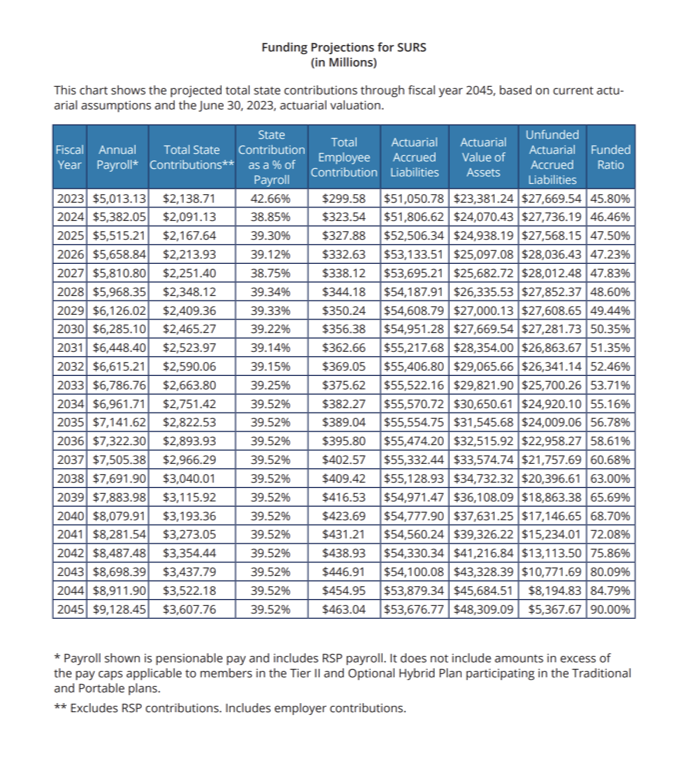
SURS funding solvency is always a hot topic when we meet with SURS retirees or soon to be retirees and could be a topic of a separate article. However, SURS funding is projected to improve over the next 20 years as Tier 2 participants begin to outnumber Tier 1 participants and retirees. We can see in the chart below (from the SURS website) that the funded ratio is only expected to increase onward from 2026. This is good news for participants, though the taxpayers of Illinois will need to bridge the gap in the intervening years.

Retirement Savings Plan

The retirement benefits under the RSP are the same for either Tier 1 or Tier 2 participants. In other words, the vesting requirements and retirement benefit options and savings rates are the same for participants no matter their hire date. 

The vesting period is still 5 years; the required employee and employer savings are the same rates and retirement age requirements are the same. An RSP participant will need 5 years of service at age 62, 8 years of service at age 55, or can retire at any age after 30 years of service. The benefit options are complex and entirely dependent on an individual’s complete financial situation. See Bluestem’s blog post for more detail on that. 

Traditional and Portable plan Differences

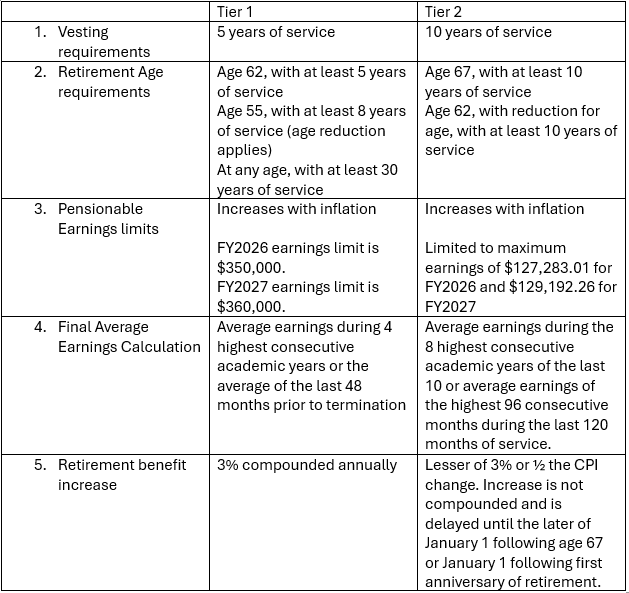
For these plans, there are significant differences between Tier 1 and Tier 2 participants.

The most significant differences are:

As you can see, Tier 2 is inferior in each of these major differences. This represents a savings in benefits SURS and the State are paying out, but also a major reduction in benefits and income for individuals who joined SURS eligibility after Jan 1, 2011. 

A person with Tier 2 benefits must draw their benefits at a later age, after more years of service, will likely be paid a smaller amount, and receive smaller annual increases.

how bluestem can help

Bluestem can assist in assessing choices around retirement readiness (under any of the above plans), help determine how your SURS benefits fit into your financial picture, and can provide education on the terminology and options of the SURS system. 

Additional information

SURS website: https://surs.org/

State Universities Annuitants Association (“SUAA”) website: https://www.suaa.org/home.  SUAA is an advocacy group which provides a unified message dedicated to preserving and protecting a strong public pension system, healthcare benefits, higher education, and the general well-being of its membership.

SUAA advocates on behalf of all faculty and staff of public universities and community colleges—both retired and current employees—their spouses and survivors, who are participants and beneficiaries of the State Universities Retirement System.

Important Disclaimer

This content has not been reviewed by or endorsed by State Universities Retirement Systems - SURS. Bluestem Financial Advisors, LLC, is an independent advisory firm not affiliated with SURS.

Reimagining Retirement: Bluestem Presents at SUAA Annual Conference

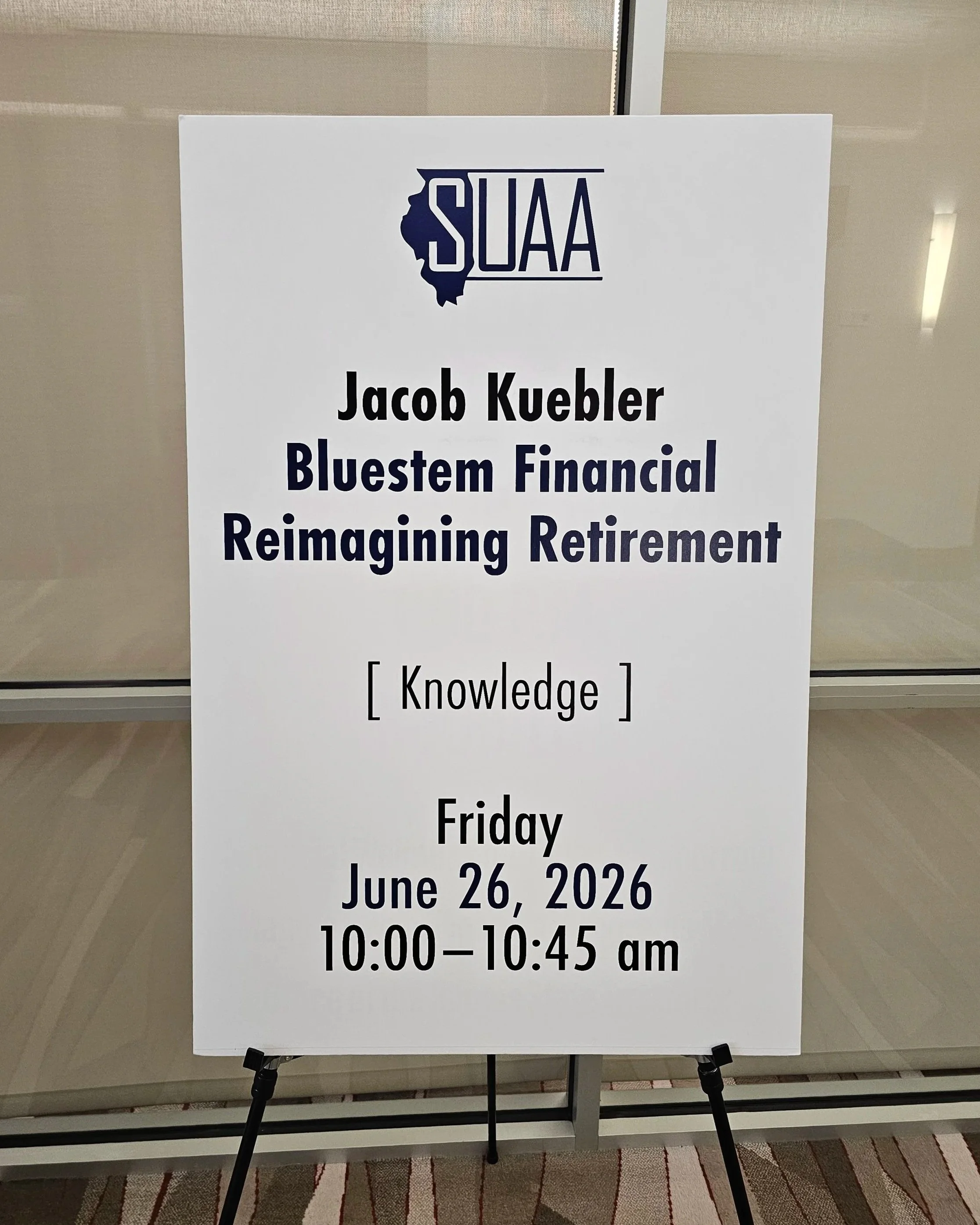
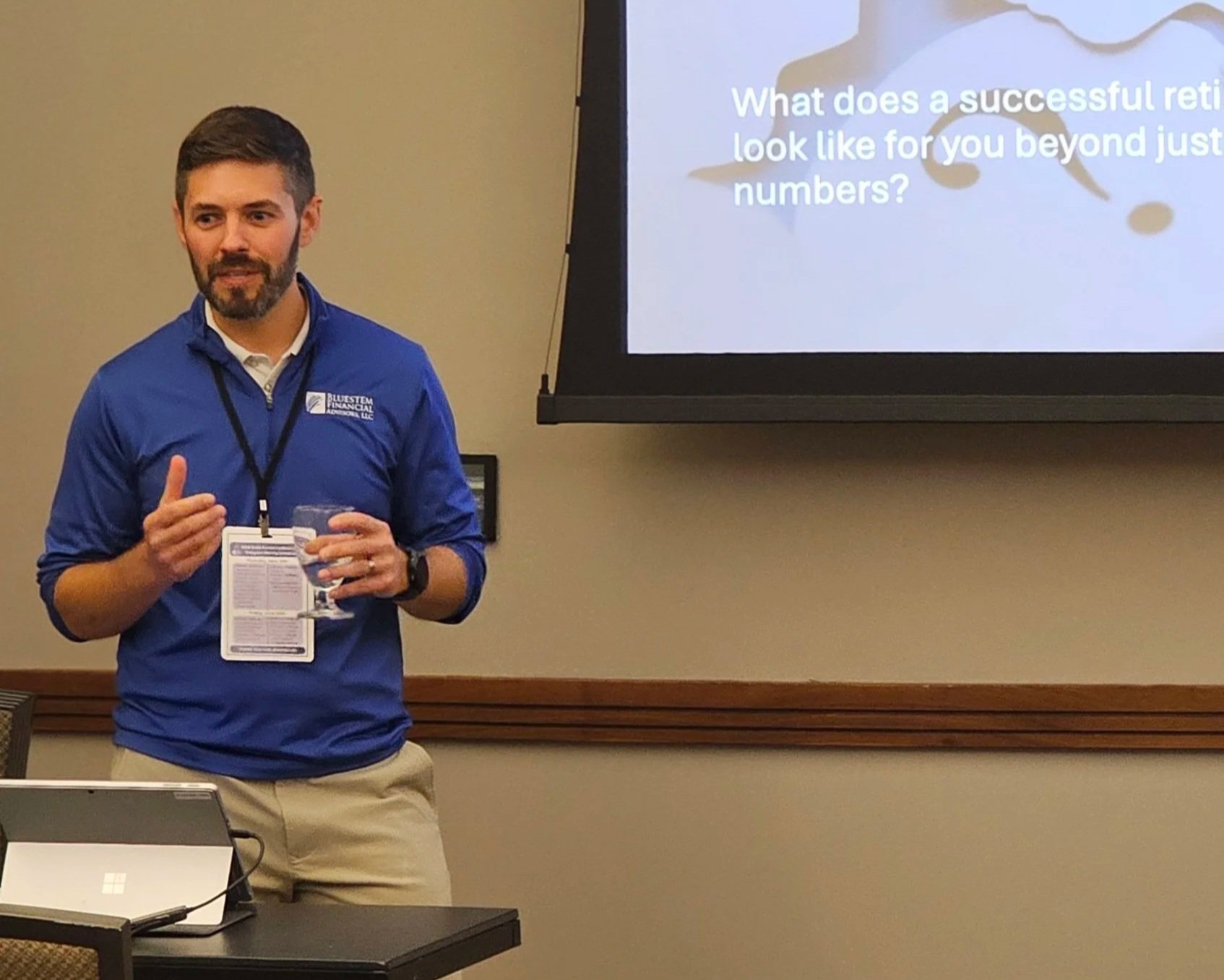
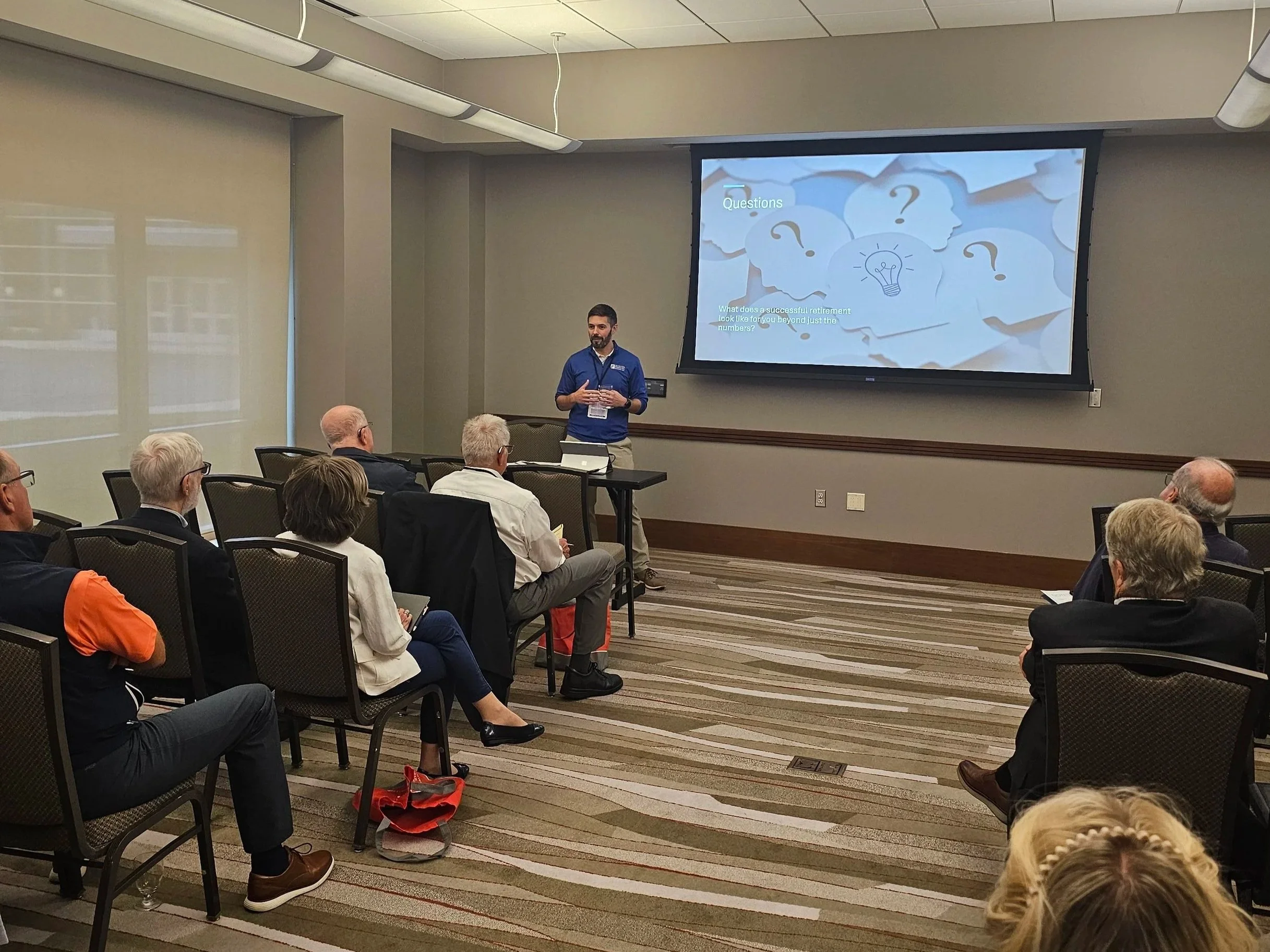
Last month, Senior Advisor Jake Kuebler was invited to present at the State University Annuitant’s Association (SUAA) annual conference. SUAA is an organization that advocates for state university employees who are a part of the State University Retirement System (SURS).

Jake presented Reimagining Retirement Beyond the Workplace, with a focus on finding enjoyment, satisfaction, and meaning and purpose in your retirement years, and what it looks like to consider those concepts in your retirement planning. You’ll find very similar themes in Jake’s Money and Happiness Blog Series!

Some of our staff was on hand to support Jake and chat with folks before and after the session.

Here at Bluestem, we have accumulated years of expertise on SURS, so teaming up with SUAA is a natural fit! We are looking forward to collaborating more with them in the future.

Faculty Phased Retirement at Illinois: A Practical Guide for Tenured and Specialized Faculty

In late 2025, the University of Illinois rolled out a new Faculty Phased Retirement Program (FPRP). This program offers tenured and other select faculty a way to build a glidepath into retirement while maintaining access to health insurance and other employee benefits. This guide offers our clients and those interested in this program an overview of the program as well as considerations for your retirement and financial plan.

Introduction to the FPRP

To qualify for the program, you must be tenured or specialized faculty at UIUC who will otherwise be eligible for retirement under the State University Retirement System (SURS) by the end of the 3-year program. Here is the eligibility for retirement under SURS (State Universities Retirement System, 2025a):

  • SURS Retirement Savings Plan, or Tier 1 Traditional / Portable - Age 55 with 8 Years of Service Credit, Age 62 with 5 Years of Service Credit, or any age with 30 Years of Service Credit.

  • Tier 2 Traditional or Portable participants - 10 Years of Service Credit at age 62.

Once accepted by your leadership and Dean, your appointment can be phased down over a period of up to three years. This allows you to stay involved in a part of your position you enjoy such as teaching, research, or supervising graduate students, and give up parts of your position you wish to reduce or eliminate. (Illinois Human Resources, 2025)

Impacts with your Pension and Retiree Health Insurance

It is important to understand this program does not change any of your elections within SURS or elect retirement under SURS. This reduces your appointment with UIUC with an agreement to fully retire by an agreed upon date. While health insurance is subsidized during this transition period, your retirement pension and health insurance benefits may be impacted.

SURS Traditional and Portable

Whether you are Tier 1 or Tier 2, your retirement benefits are determined based on a formula that factors in your years of service and final average salary. By opting into this program and reducing your appointment, you may accrue less service credit.

Example 1:

Sally is a 62-year-old professor in SURS Traditional that planned to work until age 65. She is interested in the FPRP program to see her graduate student through completion of his PhD as well as finish out her current grant funded research project. She currently has 17 years of service credit.

If she did not elect FPRP, she would accrue 3 more years of service credit and retire with 20 years at age 65. Assuming final average earnings of $150,000 and using the 2.2 rule, her pension would be $66,000 per year ($150,000 x 2.2% x 20). (State Universities Retirement System, n.d.)

If she elected FPRP, with a 66% appointment through age 65, she would only accrue 2 years of service credit over the final 3 years, ending with 19 years of service credit. Assuming Final Average Earnings of $150,000 and using the 2.2 Rule, her pension would be $62,700, a reduction of $3,300 per year.

Keep in mind, many of our faculty clients have additional sources of salary while working in a full-time appointment, such as drawing summer salary or salary supplements for leadership roles. If you were to give up these sources of income under the PFRP, you may see other impacts on your final pension calculation. These impacts would need to be calculated at the individual level as it can vary based on your final average salary and considering impacts of cost-of-living adjustments you may be entitled to if you retire earlier.

SURS Retirement Savings Plan

This pension plan determines benefits based on contributions and investment growth on the plan rather than years of service. By opting into this program, your salary would be reduced and therefore your own contributions and matching by your employer would be reduced.

Example 2:

Same facts as Example 1, except Sally is in SURS RSP. Sally contributes the mandatory 8% of her income to RSP and her employer matches this with 7.3% for total contributions of 15.3%.

Over the next 3 years and working full-time, her SURS RSP would receive contributions of $68,850 ($150,000 x 15.3% x 3).

If instead, she opts into the FPRP, her SURS RSP would receive contributions of $45,441 ($150,000 x 66% x 15.3% x 3) .

The exact impacts on retirement income are unknown as we cannot predict future investment returns or annuity rates. In either Example 1 or 2, Sally could consider “making up” some of this lost retirement income be increasing her voluntary retirement contributions via the 403b or 457 Deferred Compensation programs. However, this would further reduce her take-home pay beyond reduction in salary.

Health Insurance while Working

One of the primary benefits of the FPRP is the ability to maintain access to health insurance during the program at the same rates you pay during a full-time appointment. Normally, taking a reduced appointment that reduces your full-time equivalency below 1.0 would also come with a prorated increase in premiums to make up for the employer insurance premium subsidy. Under this program, your employer will make up that increased cost on your behalf. The details of these premium subsidies can be found at HR Resources Website - Insurance Impact Scenarios.

Health Insurance in Retirement

Once you complete the FPRP program and fully retire, you may have access to Retiree Health Insurance benefits. Eligibility of these benefits is based on your annuitization of your SURS pension and number of years of service credit. Read more about these benefits and eligibility requirements at Retiree Health Insurance Under SURS: An Explainer.

Notably, if you have less than 20 years of service reducing your appointment may reduce your eligibility for retiree health insurance benefits.

Example 3:

Going back to the facts in Example 1, if Sally does not opt into the FPRP and works until age 65, she will obtain 20 years of service credit. If she annuitizes her SURS pension, her retiree health insurance benefit is fully vested, and she will pay no premiums towards this benefit.

If she does opt into the FPRP and works until age 65 at a 66% appointment, she will only obtain 19 years of service credit. Upon annuitizing her SURS pension, she will be eligible for Retiree Health Insurance Benefits but will be responsible for 5% of the total cost each year. This is because health insurance premiums for retirees are based on number of years of service (State Universities Retirement System, 2025b).

Please note, at age 65, most participants will be required to opt into a Medicare Part A and Part B policy. While Part A generally has no premium when retired, Part B does have a Premium. You are responsible for Part B premiums, which are paid directly to Medicare, regardless of number of years of service credit. Upon reaching age 65, you would enroll in the Total Retiree Insurance Illinois Plan (TRAIL), which is currently a Medicare Advantage plan. The premiums on this are very low and therefore having less than 20 years of service credit has a minimal financial impact with regard to premiums. The impact is much larger for those retiring before age 65 or if Medicare Advantage premiums were to rise significantly later in retirement.

Bluestem’s View

The primary benefit of this program is providing flexibility in transitioning into retirement. We have seen some clients struggle with a sudden retirement, going from working full-time to fully retired. After the initial honeymoon period wears off, some feel a lack of structure and purpose without a longer period of transition. This program can provide a structured way to glide into retirement rather than making the transition from full-time work to retirement suddenly. If the time offered under this program is used to begin building post-retirement interests and purpose, it could be a positive program to consider.

See more on purpose in Money and Happiness Part II: Relationships, Purpose, and Fulfillment.

The maximum length of three years is also a downside of the program. It limits flexibility for those who still want to contribute over the long-term but adapt their work to their skills. Drawing on Arthur Brooks’ central theme from Strength to Strength, as our brains age, our cognitive strengths shift from problem-solving (“fluid intelligence”) to wisdom-based skills (“crystallized intelligence”) such as teaching, mentoring, and synthesizing knowledge. This transition can be a tremendous asset to both the university and the faculty member, as seasoned faculty can offer invaluable guidance, historical perspective, and mentorship to younger colleagues and students. Extending opportunities for experienced faculty to stay engaged beyond a fixed period allows the institution to benefit from these evolving strengths, while enabling faculty to continue making meaningful contributions in roles that leverage their accumulated expertise and insight.

Financial Considerations

The reality is, any decision to retire early is a “net negative” for the balance sheet as you are reducing your capacity to earn income, contribute to savings, and often drawing on savings sooner. That being said, if you are at or nearing financial independence, retirement is an opportunity to trade financial resources for something even more valuable — your time. As discussed above, the FPRP is likely to have some impacts on retirement income, but for many it may be manageable.

A more important consideration is, can you handle the salary reduction during the phased period? As you are not actually retired, you will not be eligible to draw your pension. Additionally, if you are not yet full retirement age for Social Security Benefits (typically 67), continued salary may limit your ability to draw benefits until you are fully retired.

In Summary

The Faculty Phased Retirement Program can offer welcome flexibility and a dignified glide path into retirement. Success depends on aligning your workload, annuitization date, and health insurance timing, subject to securing unit/dean approval. If you’d like a second set of eyes to weigh the trade‑offs and tailor a plan, especially around SURS options, retiree health insurance, and cash‑flow modeling our team is here to help. We’ve helped hundreds of faculty navigate SURS, retiree health insurance, and retirement decisions with clarity and confidence.

Schedule a call for an introductory call to learn more.

Further Reading

Illinois Human Resources. (2025). Faculty Phased Retirement Program. University of Illinois Urbana‑Champaign. https://humanresources.illinois.edu/faculty-phased-retirement-program/

University of Illinois System Human Resource Services. (n.d.). Retirement & Investment Plans. https://www.hr.uillinois.edu/benefits/retirement

State Universities Retirement System. (2025). Retiree Health Insurance and Rates. https://surs.org/benefits/insurance/

State Universities Retirement System. (2025). Retirement Eligibility. https://surs.org/retirement/eligibility/

State Universities Retirement System. (n.d.). Traditional Benefit Package – Guide [PDF]. https://surs.org/wp-content/uploads/Guide-TRD.pdf

Important Disclaimers

This content has not been reviewed by or endorsed by State Universities Retirement Systems - SURS. Bluestem Financial Advisors, LLC, is an independent advisory firm not affiliated with SURS.

SURS Retirement Savings Plan Guide Part 1 – The SURS Secure Income Portfolio (SIP)

SURS Retirement Savings Plan Guide Part 1 – The SURS Secure Income Portfolio (SIP)

Welcome to Part 1 of our multi-part series designed specifically for members of the State Universities Retirement System Retirement Savings Plan (SURS RSP) who are approaching retirement and want clear guidance on their options. This guide will help you make sense of your choices and confidently decide what to do with your account balance as you transition to retirement.