
General Financial Planning

Protecting your Financial Life in the Digital Age

The news of cyber vulnerabilities and retailer hacks seems never ending. This  past week, another major fast food chain, Jimmy Johns, announced a data  breach and possible loss of consumer payment information. Other recent big  breaches include Target and Home Depot. Then came news of another security  bug, “Bash” aka “Shellshock”, endangering the security of many websites. To  help you protect your financial information in the digital age, I compiled a list of  financial best practices and some recommendations for keeping yourself safe:

Credit versus Debit:

To protect yourself from fraud, ditch your debit card and stick with credit. Debit cards do not come with the same consumer protections as credit, even if the debit card carries a Visa or MasterCard logo. If your bank issues a debit card for ATM access, request an ATM only card that cannot be used in stores or do not carry the card unless you plan to make a cash withdrawal from an ATM.

Credit Monitoring and ID Theft Insurance? Generally I do not recommend these products. Credit monitoring only alerts you of suspicious activity. You can do this yourself by checking your credit regularly (a service we provide for our clients). As for insurance, you are not generally liable for fraudulent activity. Therefore, ID theft insurance is covering only out-of-pocket costs for fighting fraud. Insurance does not compensate for the aggravation and your time, only actual costs such as postage.

A more effective way to prevent fraudulent accounts from being established in your name is to freeze your credit with each of the three credit reporting agencies. Here is a guide offered by Financial Radio Personality, Clark Howard: Clark Howard Credit Freeze and Thaw Guide

Keep in mind that freezing your credit has its own downsides. Applying for or opening new credit will require work on your part to “thaw” your file. Also, some identify verification services rely on your credit file. Without access, you may not be able to validate yourself online.

19-08-7Paper versus Electronic account statements:

Let’s face it, paper statements are just as vulnerable as electronic. Use whichever format you prefer and the one that you will be more likely to review promptly. Reviewing statements is your best defense against unauthorized activity.

Paper Statements can get lost in the mail and potential thieves can steal from your mailbox. Best practice would be to have a locked Post Office box to receive financial mail and never mail anything sensitive except through a locked mail collection box (Blue USPS Mailbox).

For electronic statements, do not count on your financial institution to retain digital records forever. Download them to a local (secure) computer and back them up regularly. Consider automating your computer backups with a system such as Mozy, Carbonite, or Box.com.

Passwords:

Use a secure, unique password for each financial website. Make your password long (12 or more characters) with combinations of upper and lowercase, numbers and symbols. When possible, enable two-step verification. This will require a separate authentication when a website is accessed from an unrecognized or new device. The two-step verification works because an access code is sent in a text message to your phone or in an email. The code is required to access your account in addition to the usual password, and thieves don’t have access to your phone or email from their device.

Consider a password manager system to generate and store your passwords. I use a system called LastPass. I only need to memorize one password, and LastPass can store all the rest. However, make sure your master password is very secure and change it often.

Shopping and Banking Online:

Only access financial information from your own devices and only if you have up-to-date security software with real time protection. Public computers or those used by others (e.g. in hotels or internet cafes) may have spyware or key loggers trying to capture passwords and other secure data.

Avoiding Scams:

Reputable institutions will not call you to request verification of non-public information (Social Security Numbers, Account Numbers, etc). Calls such as these are most likely scams. If you get a call requesting this type of information, hang up and call back the institution with a number you know to be real such as the phone number on the back of a credit card or website. In addition, the IRS almost never calls taxpayers, especially as first contact. Any notices regarding your returns will be by a letter sent through the US Postal Service.

Have any more tips? Leave a comment with your thoughts or suggestions.
Real Change Happens at the Margin

I recently finished my second half marathon, finishing the race just under my target time of two hours. While pleased with reaching a personal goal, there is nothing really compelling about my story. No overnight success, no major rise to overcome great obstacles. There was a time when running for fun would sound crazy, let alone running for hours on end. I started running 14 years ago to get into shape. I cannot say I really even enjoyed it at the beginning. My first runs were on a basement treadmill, 1 mile at a time. Soon a single mile was easy, so I pushed it to two and then three. For a challenge I decided to run a 5k, which lead to another and then another. Each time I aimed to cut my time by pushing my regular runs just a little faster and a little further. Each time I hit a goal, I moved the target just a little bit further. A little longer distance, a little shorter time.

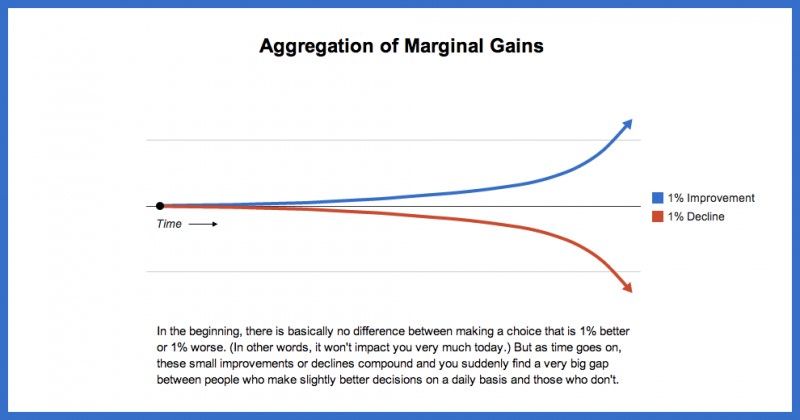
My evolution has been slow and incremental. My progress from year to year is minimal, barely even noticeable. Review these changes over years, and the results are slightly more impressive. Change happened from minor adjustments made over time and the result of those adjustments compounded over time.

In a post appearing on The Daily Good, author James Clear outlines this same strategy. He describes how marginal changes led Great Britain’s cycling team to win the Tour de France in 2012 and 2013. Then, he shows the following illustration of how small changes, stacked onto one another lead to substantial changes over time.

Click image to view the full post.

This is a principle that we use daily with our Financial Planning clients. Big changes may happen at the beginning of our relationship, but planning is a long term process. An incremental series of good decisions and judgment based on an end goal will lead to long term success. As we work together year after year, we provide the long term perspective that keeps decision making on track and also reduces errors in behavior.

How can you apply this to your own financial life? Comment below if you want to share your own story.

Millennials' Guide to Getting Rich

8193dVCy1uL._SL1500_1.jpg

If you read the rest of this post, you will find my title to be a bit flippant.  Had I added the work "Quickly" to the end, it would be downright misleading.  Except for the rare instance where someone inherits a fortune, wins the lottery or marries a multi-millionaire, getting rich is a slow and boring process.  This fact is mostly overlooked by the media.  Boring does not sell newspapers or generate web hits and therefore good financial advice is rarely a media event. That is why I was excited to see some press on a newly released e-Book written by Financial Advisor and author William Bernstein for Millennials (aka Gen Y, born 1980's through early 2000's).  Concisely written, the book summarizes how to actually build financial freedom, aka wealth.  Spoiler alert, the method is simple but the application will take effort on your part.

The book is so short, it is hardly worth summarizing on this post.  You should seriously consider taking 30 minutes to read the ~14 page guide yourself.  Purchase the e-Book for $0.99 on Amazon's Kindle Library or download free in PDF format.

What really resonates about this book is the simplistic method he advocates; live below your means (save 15%), educate yourself on the basics, keep the portfolio simple because you will not beat the market.  These are all key parts of our approach to financial planning.  Success comes not from taking big risks or complex strategies, but by being diligent and making good decisions.

I will not underplay the "making good decisions" factor.  We are all human and we all make errors in judgment.  Some errors are unavoidable, but others come from fear, greed or other emotional roadblocks.  Decisions need to be made objectively in context of your current situation and future goals.  Doing this on your own is incredibly difficult.  Even the most savvy among us regularly make less than objective decisions.  For many, this is the value of having a Financial Planner.  To act as the objective, informed third party and provide a fresh perspective.

Be sure to check out some of the press on this book, including an interview on NPR's Here and Now and a summary by columnist Scott Burns.

Behave your way to Success

IMG_0891.jpg

This past week I had the opportunity to visit Salt Lake City for the Spring Conference of the National Association of Personal Financial Advisors (NAPFA). The theme of this year’s conference was Behavioral Finance. A hybrid of psychology and economics, this exciting field aims to explain our behavior and decision making in our personal finances. Some examples of application to our behaviors around money include:

  • Tendency of individuals to overestimate their own abilities and believe they are above average. This explains why so many fall for the fallacy of active investment management. They try to beat the market by selecting investment securities based on prior performance or time their purchase of securities to beat the market.
  • Focusing too narrowly on frames of references or over-weighting recent events. For instance, a short term fluctuation in the market might cause an individual to perceive higher risk than actual longer-term risk and sell stocks at exactly the wrong time.
  • The power of momentum, when we fail to take action that is in our best interest. In other words, procrastinating on actions we know we need to make but simply put off. This may affect getting that life insurance policy, signing our estate documents or rebalancing our portfolio.

The point of Behavioral Finance research is to explain how our past experience and mental processes can get in the way of day to day decisions. Even more importantly, it seeks to understand how to overcome these mental biases. Dr. Meir Statman, Professor and Author of What Investors Really Want, describes these biases as similar to having less than perfect vision. By understanding where our behavior and economics intersect, we can correct that vision and make better decisions.

Understanding behavior and how it can affect reaching financial goals is a top value of hiring a Financial Planner. Value does not come from number crunching, projections, or investment management alone. Value received is your advisor seeing the whole picture of your life, and tempering emotions with appropriate decision making. A trusted advisor encourages you to reach your goals by keeping you accountable and on track through a series of small, incremental decisions.

5 Excuses for Not Hiring a Financial Advisor

(And why you should rethink the excuses)Untitled

Are you thinking about hiring a Financial Planner, but failing to take action?  We see many people who put off the decision for far too long, costing them time or money.  Here are some common reasons many fail to hire an advisor  and misinformation that you may have heard about financial advisors.

#1 – I do not have enough money

I will concede that Financial Planners have a reputation for only serving the wealthy.  Many firms  have portfolio minimums, often in the mid-six-figures or more.  However, Financial Planning as a profession (not sales as discussed below) is relatively young and still evolving.  Early models of the 1980’s and 90’s were built around investment management.  Financial planning was a manual, time intensive process.  Large portfolios were needed to cover the high cost of doing comprehensive financial planning.

However, this is rapidly changing.  Financial Planners, like all entrepreneurs, are continuously developing new business models to serve a wider base of clients.  New efficient technology has pushed down the cost of providing services.  There are many groups of advisors and companies who provide financial planning services to a wider audience.  For instance, online companies such as LearnVest are springing up to provide basic planning services at ultra-low cost.  For more customized services, there are advisors who provide hourly consultations, such as those in the Garrett Planning Network.  Finally, there are advisors that provide ongoing, holistic services to the middle market, members of the Alliance of Comprehensive Planners.

My point here is, there are many types of advisors out there.  You have to be willing to put a little time into your search to find the right fit. The right advisor will provide services in line with your needs, have expertise in issues you face, and communicate with you in a manner that you understand and trust.

At Bluestem, we not have a minimum portfolio size for new clients.  We are a growing firm and always accepting new clients, but we do limit our growth each year to ensure that we provide the best service we can to new and existing clients.  This means we are selective about the clients we take on in order to ensure that our expertise and services match their needs.

#2 – Financial Planning means “Sales”

I sometimes get uncomfortable when people ask me what I do for a living.  Not because I am ashamed, but because of the response I get to saying Financial Planner.  There is is a lot of negative connotation behind the title.

The problem lies in the lack of regulation or consistency of the title Financial Planner/Advisor.  Pretty much anyone can use the title, regardless if they are actually providing planning services or are just a salesperson for investments or insurance products.   There have been efforts to clarify, but the sales industry is quick to mimic true financial advisors or confuse consumers. Even so, those selling products cannot copy what a true Financial Planner really does, so let me tell about that.

A true financial planner is interested in who you are.  They want to learn your goals, ambitions and values.  They understand that maximizing your income and wealth are important, but only because that helps you achieve something more.  Money is not the end result.  Once they understand who you are and what you are about, they help you begin piecing together a financial strategy to achieve those goals and values.

They understand there are many pieces to your financial life to manage; human capital (career), taxes, insurance, children, legal, retirement, and the list goes on.  A planner is there to help you make decisions that encompass all the different areas.

I have been called a Jack of all Trades and Master of None.  In the context, it was meant to be negative, but it has some truth.  My knowledge is broad by design.  I need personal skills to learn about you and technical skills to see how all the pieces fit together.  I also have to recognize how changing one financial piece of your life will affect another.  I am a professional and recognize my limitations.  When depth of knowledge is needed, I maintain an arsenal of professionals to assist.  Attorneys, Insurance Agents, CPAs, Real Estate Agents, and Brokers may be brought in when needed.  Alone they may not know the whole picture, but I am there to assure that a cohesive result is achieved for my clients.

If you are looking to hire an advisor, be willing to ask lots of questions.  You should be especially interested in hearing about the process of working with the advisor.  Results are important, but there are no guarantees in life.  There are too many unknown variables for a professional to make promises they cannot keep.  Do not be influenced by flashy marketing with anecdotal success stories and past performance statistics.  That may not indicate success for your future.  Focus on hiring someone who has a solid process to help you evaluate your needs, anticipate changes and help you adjust course as needed.

#3 – I can do it myself

I concede, this one is actually true.  You probably can do it yourself. Be honest with yourself, will you?  Will you devote the time to set goals, educate yourself, evaluate important financial decisions, monitor your progress and adjust as needed?  Most of us will not.  It is too easy to get caught up in day-to-day life to think about our own future objectively or strategically.

Would it surprise you to know I hired my own Financial Advisor?  It is not because I cannot do it myself.  It is because I know there is value in having an objective third party.  Someone who can cut through my own emotional and mental roadblocks.  Someone who can force me to take a long term view and someone who can coach and encourage me to keep moving in the right direction.

There are many reasons someone might hire an advisor.  Some people like to manage their own plan, but hire an advisor for an objective review to validate that they are on the right track.  Others find they have little patience for the process and do not enjoy learning the ins and outs of financial planning. They hire an advisor to delegate and turn over the responsibility to a competent planner.

#4 – I cannot afford to hire an Advisor

Many of us are willing to make an investment if we expect the future benefits will be greater than the initial outlay.  The same should be true of hiring an advisor.  I believe any advisor you hire should, in the long term, add more value than the cost of their services

As clichéd as it may sound, sometimes peace of mind can be one of the biggest values in hiring an advisor.  Research from the Consumer Federation of America (CFA) and Certified Financial Planner Board of Standards (CFP Board) has shown that families that take time to plan have better financial preparedness for meeting goals and dealing with emergencies, save more and are more confident about their finances. Is it worth your money to sleep better at night, avoid arguments with a spouse over money, or to know you are on the right track?

Maybe you are skeptical and want to see hard dollar savings.  Morningstar, an investment research firm, has attempted to quantify the value of hiring an advisor.  They define gamma as value an advisor adds to an individual through the financial planning process.  These values include added investment returns through optimizing portfolio allocation, withdrawal strategies and tax savings.  They postulate the added return could be as high as 1.59% of your portfolio.

This research does not even include the savings of avoiding mistakes such as incorrect tax returns, buying the wrong financial product, paying unnecessary fees to high cost institutions and financial products.  How about the cost of inaction?  How much are you paying because you fail to take action?

#5 – This is not the right time OR I do not have the time

I hear this a lot.  Someone will reach out because they are experiencing a life transition that comes with a financial pain or have an important decision to make.  The person is so caught up in the life transition, they ignore or procrastinate making needed financial decisions.  They deal with the symptoms, not the underlying problem.

I think a person’s overall health and well-being is like a wagon wheel.  Each spoke represents one aspect of the person’s life.  The spokes include physical, mental, relationship, spiritual/moral/religious, and financial health.  In order for the wheel to be round and turn easily, you need to devote equal time and energy to all.  Otherwise, your wheel may become flat in certain sections and have trouble moving you forward.

Another way to put it, if you ignore one area of overall health and balance, you may end up harming the whole system.  Taking the time to make a plan will take an investment of time and energy, but will pay off with future peace of mind, flexibility and independence.